The Center of the Universe

St Croix, United States Virgin Islands

MOSLER'S LAW: There is no financial crisis so deep that a sufficiently large net increase in public spending cannot deal with it.

Archive for the 'Inflation' Category


CPI

Posted by WARREN MOSLER on 17th June 2009


[Skip to the end]


Karim writes:

No outliers.

  • Headline CPI up 0.096% m/m and -1.3% y/y; lowest y/y rate since 1950 will fall further over next 2mths before rising again in August.
  • Wild swings in headline from 5.6% to -2% in a 12mth period reinforcing Fed focus on core
  • Core up .145% m/m and 1.8% y/y
  • OER up 0.1%, med and education up 0.3%, tobacco down 0.3% after 20% rise in prior 2mths
  • Core likely to drift down to 1% y/y by yr-end


[top]

http://www.moslereconomics.com/wp-content/plugins/sociofluid/images/digg_48.png http://www.moslereconomics.com/wp-content/plugins/sociofluid/images/stumbleupon_48.png http://www.moslereconomics.com/wp-content/plugins/sociofluid/images/delicious_48.png http://www.moslereconomics.com/wp-content/plugins/sociofluid/images/newsvine_48.png http://www.moslereconomics.com/wp-content/plugins/sociofluid/images/technorati_48.png http://www.moslereconomics.com/wp-content/plugins/sociofluid/images/facebook_48.png http://www.moslereconomics.com/wp-content/plugins/sociofluid/images/twitter_48.png

Posted in Housing, Inflation, Karim | 1 Comment »

Twin deficit terrorists Ferguson and Buiter

Posted by WARREN MOSLER on 14th June 2009


[Skip to the end]

This is the exact same line Niall Ferguson is spewing.
He also says the two choices are inflating or defaulting.

The inflation would be from too much aggregate demand and a too small output gap.

That would mean that fatefull day would be an economy with maybe 4% unemployment and 90%+ capacity utilization and an overheating economy in general.

Sounds like that’s the goal of deficit spending to me- so in faccct he’s saying deficit spending works with his rant on why it doesn’t.

And if we do need to raise taxes to cool things down some day, we can start with a tax on interest income if we want to cut payments to bond holders.

Regarding the supposed default alternative to inflation, in the full employment and high capacity utilization scenario that might call for a tax increase to cool it down, I don’t see how default fits in or why it would even be considered.

In fact, with our countercyclical tax structure, strong growth that follows deficits automatically drives down the deficit, and can even drive it into surplus, as happened in the 1990’s. In that case one must be quick to reverse the growth constraining surplus should the economy fall apart as happend shortly after y2k.

Feel free to pass this along to either.

The fiscal black hole in the US

June 12 (FT)—US budgetary prospects are dire, disastrous even. Without a major permanent fiscal tightening, starting as soon as cyclical considerations permit, and preferably sooner, the country is headed straight for a build up of public debt that will either have to be inflated away or that will be ‘resolved’ through sovereign default.


[top]

http://www.moslereconomics.com/wp-content/plugins/sociofluid/images/digg_48.png http://www.moslereconomics.com/wp-content/plugins/sociofluid/images/stumbleupon_48.png http://www.moslereconomics.com/wp-content/plugins/sociofluid/images/delicious_48.png http://www.moslereconomics.com/wp-content/plugins/sociofluid/images/newsvine_48.png http://www.moslereconomics.com/wp-content/plugins/sociofluid/images/technorati_48.png http://www.moslereconomics.com/wp-content/plugins/sociofluid/images/facebook_48.png http://www.moslereconomics.com/wp-content/plugins/sociofluid/images/twitter_48.png

Posted in Deficit, GDP, Government Spending, Inflation | 87 Comments »

Trichet Sees Automatic Exit From ECB’s Non-Standard Measures

Posted by WARREN MOSLER on 5th June 2009


[Skip to the end]

The ECB remains way ahead of the fed regarding monetary operations.
It has been setting rates and letting quantity adjust and now addresses
unfounded concerns of ‘exit strategies’ head on.

(I take issue only to the extent of the potential inflationary implications and influence on growth and employment of interest rate policy in general, but that’s another story.)

The covered bond purchase could have utilized a rate target rather than a quantity target but their policy might not be to target a specific rate.

Also note they accept collateral down to a bbb rating from their member banks, which is includes bank paper and is functionally very close to unsecured lending- a policy that i have been suggesting would have served the fed well from the beginning of the crisis.

Trichet Sees Automatic Exit From ECB’s Non-Standard Measures

June 5 (Bloomberg) — European Central Bank President Jean- Claude Trichet said banks will seek less credit from the ECB when the economy improves, automatically reducing the amount of money in the system and ensuring a non-inflationary recovery.

By concentrating its non-standard policy measures on the supply of unlimited liquidity to banks, the ECB has ensured it has “an in-built exit strategy,” Trichet said in a speech in Warsaw today. “That is, when tensions in financial markets ease, banks will automatically seek less credit from the ECB.

This will be a decisive element in ensuring a non-inflationary recovery.”

The Frankfurt-based ECB, which has cut its benchmark interest rate to a record low of 1 percent, has said it will loan banks as much money as they need for up to 12 months and pledged to buy 60 billion euros ($85 billion) of covered bonds in an effort to revive lending. The ECB yesterday lowered its economic forecasts for this year and next. It now expects the economy of the 16 nations using the euro to shrink by about 4.6 percent this year before returning to positive quarterly growth rates by mid-2010.

“Once the macroeconomic environment improves, the Governing Council will ensure that the measures taken can be quickly unwound and the liquidity provided absorbed,” Trichet said. “Hence, any threat to price stability over the medium and longer term will be effectively countered in a timely fashion.”

Merkel’s Warning

German Chancellor Angela Merkel on June 2 scolded the Federal Reserve and Bank of England for pumping too much money into their economies and said that by deciding to buy covered bonds, the ECB had “bowed somewhat to international pressure.”

She urged a return to a “policy of reason.”

Trichet said the ECB’s “bold yet solidly-anchored response” to the worst economic crisis since World War II is “encouraging.” While long-term inflation expectations remain anchored around the ECB’s 2 percent limit, “our measures show some signs of revival in the functioning of money markets in Europe,” he said.

Trichet added that the crisis has not altered the ECB’s primary objective of maintaining price stability. “This objective will always provide the context and limits within which our course of action is framed and enacted.”

Trichet Says ECB Will Buy Covered Bonds Next Month

by Neil Unmack

June 4 (Bloomberg) — The European Central Bank will start buying 60 billion euros ($85 billion) of three- to 10-year covered bonds from July, President Jean-Claude Trichet said.

The central bank will buy bonds rated at least BBB- in the primary and secondary markets until June 2010, but doesn’t plan to purchase other assets, the ECB said after policy makers held interest rates at a record-low 1 percent. The ECB said on May 7 it will buy covered bonds in a bid to revive the market, which lenders use to finance mortgages and public-sector loans.

Covered bond issuance increased after the ECB announced the purchase program last month, with banks selling 26.8 billion euros of the debt, according to data compiled by Bloomberg. The $2.8 trillion market had been roiled by the credit crisis, and sales had halved to 48.6 billion euros by May 7, compared with 99.4 billion euros in the same period a year earlier.

“It’s supportive for the primary and secondary covered bond market,” said Leef Dierks, a credit analyst at Barclays Capital in Frankfurt. “We expect the issuance window to remain open, and believe that the positive momentum in the secondary market will continue.”

To be included in the ECB’s purchase plan, covered bonds “must be eligible for use as collateral in the euro system’s credit operations,” Trichet said. The bonds must “have as a rule a volume of about 500 million euros or more and in any case not lower than 100 million euros,” he said.

Bond Eligibility

Bonds bought by the central bank must comply with the so- called UCITS directive, a European regulatory framework for mutual funds, or have “similar safeguards,” Trichet said, without being more specific.

“They want to get the most bang for their euro, and that means helping the bonds that will have the widest investor support in the market,” said Ted Lord, head of covered bonds at Barclays.

The ECB said it will buy bonds through “direct purchases” rather than following the Bank of England’s example of using auctions.

“We would like more clarity on how these direct purchases will work,” said Heiko Langer, a covered bond analyst at BNP Paribas SA in London. “Will we know how much they have bought, what they have bought, and at what price?”

Regarding the euro region’s economy, Trichet said confidence may improve more quickly than has been forecast.

“Risks to the economic outlook are balanced,” he said. “On the positive side” there are “stronger-than-anticipated effects from stimulus measures underway and other policy measures taken. Annual inflation rates are projected to decline further and become negative over the coming months.”

Covered bonds are backed by real-estate or public-sector debt and tend to have a higher rating than straight corporate bonds because they’re also supported by a borrower’s pledge to pay.


[top]

http://www.moslereconomics.com/wp-content/plugins/sociofluid/images/digg_48.png http://www.moslereconomics.com/wp-content/plugins/sociofluid/images/stumbleupon_48.png http://www.moslereconomics.com/wp-content/plugins/sociofluid/images/delicious_48.png http://www.moslereconomics.com/wp-content/plugins/sociofluid/images/newsvine_48.png http://www.moslereconomics.com/wp-content/plugins/sociofluid/images/technorati_48.png http://www.moslereconomics.com/wp-content/plugins/sociofluid/images/facebook_48.png http://www.moslereconomics.com/wp-content/plugins/sociofluid/images/twitter_48.png

Posted in Articles, ECB, Inflation, Interest Rates | 4 Comments »

Claims/ECB/BOC

Posted by WARREN MOSLER on 4th June 2009


[Skip to the end]

  • Initial claims down 4k to 621k
  • Continuing claims down 15k, first drop in 2009
  • Some possibility of Memorial Day week distorting data
  • Both measures consistent with ongoing job losses and rising unemployment rate, but a slower pace than in recent months
  • Have no bearing on tomorrow’s numbers as data came after survey week for NFP.

Interesting focus on FX from both ECB and BOC this morning:

From BOC:

–In recent weeks, financial conditions and commodity prices have improved significantly, and consumer and business confidence

have recovered modestly. If the unprecedentedly rapid rise in the Canadian dollar (which reflects a combination of higher

commodity prices and generalized weakness in the U.S. currency) proves persistent, it could fully offset these positive factors.

–Key is term ‘unprecedented’ and that rise in C$ is not fully explained by the rise in commodity prices.
From ECB:

–ECB staff updated its forecasts for growth and inflation. Main change was in 2009 growth forecast:

Now -4.1% to -5.1% from estimates of -2.2% to -3.2% in March

Trichet stated: “its very important u.s. repeats strong dollar policy”.

The Euro is not trading far from levels that Trichet described as ‘brutal’ in the past.


[top]

http://www.moslereconomics.com/wp-content/plugins/sociofluid/images/digg_48.png http://www.moslereconomics.com/wp-content/plugins/sociofluid/images/stumbleupon_48.png http://www.moslereconomics.com/wp-content/plugins/sociofluid/images/delicious_48.png http://www.moslereconomics.com/wp-content/plugins/sociofluid/images/newsvine_48.png http://www.moslereconomics.com/wp-content/plugins/sociofluid/images/technorati_48.png http://www.moslereconomics.com/wp-content/plugins/sociofluid/images/facebook_48.png http://www.moslereconomics.com/wp-content/plugins/sociofluid/images/twitter_48.png

Posted in ECB, Employment, Inflation, Interest Rates | 6 Comments »

PIMCO’S Gross proposes tax increase

Posted by WARREN MOSLER on 4th June 2009


[Skip to the end]

Raise taxes with unemployment rising due to a shortage in aggregate demand?

Just in case you thought the great marketer understood the monetary system:

Pimco’s Gross: Maybe Obama Should RAISE Taxes

By: JeeYeon Park

June 3 (CNBC) — Inflation is likely three to five years down the road, and investors should stay relatively close to the front end of the yield curve where the bond prices are protected by the Fed position of low Fed funds and interest rates, said Bill Gross, co-CIO and founder of Pimco.

“Further out on the curve, anticipate deterioration in inflation, a deterioration possibility in terms of the dollar, which will produce negative returns for those long-dated securities,” Gross told CNBC.

Gross said the recovery is being driven by a $2 trillion annualized deficit. To take its place in the economy would require at least $1 trillion increase in consumption and investment, which would be quite challenging as baby boomers and consumers become more thrifty.

He also said the Obama administration should cut back on inefficient defense programs — and consider raising taxes.


[top]

http://www.moslereconomics.com/wp-content/plugins/sociofluid/images/digg_48.png http://www.moslereconomics.com/wp-content/plugins/sociofluid/images/stumbleupon_48.png http://www.moslereconomics.com/wp-content/plugins/sociofluid/images/delicious_48.png http://www.moslereconomics.com/wp-content/plugins/sociofluid/images/newsvine_48.png http://www.moslereconomics.com/wp-content/plugins/sociofluid/images/technorati_48.png http://www.moslereconomics.com/wp-content/plugins/sociofluid/images/facebook_48.png http://www.moslereconomics.com/wp-content/plugins/sociofluid/images/twitter_48.png

Posted in Bonds, Deficit, Government Spending, Inflation | 3 Comments »

Dallas Fed interview

Posted by WARREN MOSLER on 25th May 2009


[Skip to the end]

Don’t Monetize the Debt

by Mary Anastasia O’Grady

May 23 (WSJ) — From his perch high atop the palatial Dallas Federal Reserve Bank, overlooking what he calls “the most modern, efficient city in America,” Richard Fisher says he is always on the lookout for rising prices. But that’s not what’s worrying the bank’s president right now.
His bigger concern these days would seem to be what he calls “the perception of risk” that has been created by the Fed’s purchases of Treasury bonds, mortgage-backed securities and Fannie Mae paper.

Mr. Fisher acknowledges that events in the financial markets last year required some unusual Fed action in the commercial lending market. But he says the longer-term debt, particularly the Treasurys, is making investors nervous. The looming challenge, he says, is to reassure markets that the Fed is not going to be “the handmaiden” to fiscal profligacy. “I think the trick here is to assist the functioning of the private markets without signaling in any way, shape or form that the Federal Reserve will be party to monetizing fiscal largess, deficits or the stimulus program.”

If he actually understood it I would expect him to say the concept is inapplicable with a non convertible currency and floating exchange rate regime.

Richard Fisher.

The very fact that a Fed regional bank president has to raise this issue is not very comforting. It conjures up images of Argentina. And as Mr. Fisher explains, he’s not the only one worrying about it. He has just returned from a trip to China, where “senior officials of the Chinese government grill[ed] me about whether or not we are going to monetize the actions of our legislature.” He adds, “I must have been asked about that a hundred times in China.”

Without knowing the right answer which is that lending is in no case reserve constrianed.
Causation runs from loans to deposits and reserves, and not from reserves to loans.

A native of Los Angeles who grew up in Mexico, Mr. Fisher was educated at Harvard, Oxford and Stanford.

Must have skipped the classes in reserve accounting.

He spent his earliest days in government at Jimmy Carter’s Treasury. He says that taught him a life-long lesson about inflation. It was “inflation that destroyed that presidency,” he says. He adds that he learned a lot from then Fed Chairman Paul Volcker, who had to “break [inflation's] back.”

Deregulating natural gas in 1978 is what broke the back of inflation as utilities switched from crude to natural gas and even cuts of 15 million barrels per day by OPEC were not enough to keep control of prices.
Mr. Fisher has led the Dallas Fed since 2005 and has developed a reputation as the Federal Open Market Committee’s (FOMC) lead inflation worrywart. In September he told a New York audience that “rates held too low, for too long during the previous Fed regime were an accomplice to [the] reckless behavior” that brought about the economic troubles we are now living through. He also warned that the Treasury’s $700 billion plan to buy toxic assets from financial institutions would be “one more straw on the back of the frightfully encumbered camel that is the federal government ledger.”

In a speech at the Kennedy School of Government in February, he wrung his hands about “the very deep hole [our political leaders] have dug in incurring unfunded liabilities of retirement and health-care obligations” that “we at the Dallas Fed believe total over $99 trillion.”

Hopefully he is worried about possible inflation and not solvency.

In March, he is believed to have vociferously objected in closed-door FOMC meetings to the proposal to buy U.S. Treasury bonds. So with long-term Treasury yields moving up sharply despite Fed intentions to bring down mortgage rates, I’ve flown to Dallas to see what he’s thinking now.

Hopefully he is concerned with the purchases possibly lowering interest rates too much for his liking and not about the size of the fed’s balance sheet.

Regarding what caused the credit bubble, he repeats his assertion about the Fed’s role: “It is human instinct when rates are low and the yield curve is flat to reach for greater risk and enhanced yield and returns.” (Later, he adds that this is not to cast aspersions on former Fed Chairman Alan Greenspan and reminds me that these decisions are made by the FOMC.)

“The second thing is that the regulators didn’t do their job, including the Federal Reserve.” To this he adds what he calls unusual circumstances, including “the fruits and tailwinds of globalization, billions of people added to the labor supply, new factories and productivity coming from places it had never come from before.” And finally, he says, there was the ‘mathematization’ of risk.” Institutions were “building risk models” and relying heavily on “quant jocks” when “in the end there can be no substitute for good judgment.”

Never does mention the role of fiscal policy. Like the massive 2003 retro tax cuts and spending increases that drove the next few years, including housing. Helped of course by the lender fraud.

What about another group of alleged culprits: the government-anointed rating agencies? Mr. Fisher doesn’t mince words. “I served on corporate boards. The way rating agencies worked is that they were paid by the people they rated. I saw that from the inside.” He says he also saw this “inherent conflict of interest” as a fund manager. “I never paid attention to the rating agencies. If you relied on them you got . . . you know,” he says, sparing me the gory details. “You did your own analysis. What is clear is that rating agencies always change something after it is obvious to everyone else. That’s why we never relied on them.” That’s a bit disconcerting since the Fed still uses these same agencies in managing its own portfolio.

Agreed. Can’t have it both ways. And now they are threatening to downgrade the US government as well

I wonder whether the same bubble-producing Fed errors aren’t being repeated now as Washington scrambles to avoid a sustained economic downturn.

He surprises me by siding with the deflation hawks. “I don’t think that’s the risk right now.” Why? One factor influencing his view is the Dallas Fed’s “trim mean calculation,” which looks at price changes of more than 180 items and excludes the extremes. Dallas researchers have found that “the price increases are less and less. Ex-energy, ex-food, ex-tobacco you’ve got some mild deflation here and no inflation in the [broader] headline index.”

Mr. Fisher says he also has a group of about 50 CEOs around the U.S. and the world that he calls on, all off the record, before almost every FOMC meeting. “I don’t impart any information, I just listen carefully to what they are seeing through their own eyes. And that gives me a sense of what’s happening on the ground, you might say on Main Street as opposed to Wall Street.”

It’s good to know that a guy so obsessed with price stability doesn’t see inflation on the horizon. But inflation and bubble trouble almost always get going before they are recognized. Moreover, the Fed has to pay attention to the 1978 Full Employment and Balanced Growth Act — a.k.a. Humphrey-Hawkins — and employment is a lagging indicator of economic activity. This could create a Fed bias in favor of inflating. So I push him again.

“I want to make sure that your readers understand that I don’t know a single person on the FOMC who is rooting for inflation or who is tolerant of inflation.” The committee knows very well, he assures me, that “you cannot have sustainable employment growth without price stability. And by price stability I mean that we cannot tolerate deflation or the ravages of inflation.”

Mr. Fisher defends the Fed’s actions that were designed to “stabilize the financial system as it literally fell apart and prevent the economy from imploding.” Yet he admits that there is unfinished work. Policy makers have to be “always mindful that whatever you put in, you are going to have to take out at some point. And also be mindful that there are these perceptions [about the possibility of monetizing the debt], which is why I have been sensitive about the issue of purchasing Treasurys.”

Yes, seems the Fed is worried about perceptions they know not to be true, but struggles to come with a way to communicate the operational realities.

He returns to events on his recent trip to Asia, which besides China included stops in Japan, Hong Kong, Singapore and Korea. “I wasn’t asked once about mortgage-backed securities. But I was asked at every single meeting about our purchase of Treasurys. That seemed to be the principal preoccupation of those that were invested with their surpluses mostly in the United States. That seems to be the issue people are most worried about.”

As I listen I am reminded that it’s not just the Asians who have expressed concern. In his Kennedy School speech, Mr. Fisher himself fretted about the U.S. fiscal picture. He acknowledges that he has raised the issue “ad nauseam” and doesn’t apologize. “Throughout history,” he says, “what the political class has done is they have turned to the central bank to print their way out of an unfunded liability. We can’t let that happen. That’s when you open the floodgates. So I hope and I pray that our political leaders will just have to take this bull by the horns at some point. You can’t run away from it.”

Does not sound like he understands, operationally, what that is currently all about, but instead still uses gold standard rhetoric.

Voices like Mr. Fisher’s can be a problem for the politicians, which may be why recently there have been rumblings in Washington about revoking the automatic FOMC membership that comes with being a regional bank president. Does Mr. Fisher have any thoughts about that?

This is nothing new, he points out, briefly reviewing the history of the political struggle over monetary policy in the U.S. “The reason why the banks were put in the mix by [President Woodrow] Wilson in 1913, the reason it was structured the way it was structured, was so that you could offset the political power of Washington and the money center in New York with the regional banks. They represented Main Street.

Yes, there is a power struggle going on in the Fed

“Now we have this great populist fervor and the banks are arguing for Main Street, largely. I have heard these arguments before and studied the history. I am not losing a lot of sleep over it,” he says with a defiant Texas twang that I had not previously detected. “I don’t think that it’d be the best signal to send to the market right now that you want to totally politicize the process.”

Speaking of which, Texas bankers don’t have much good to say about the Troubled Asset Relief Program (TARP), according to Mr. Fisher. “Its been complicated by the politics because you have a special investigator, special prosecutor, and all I can tell you is that in my district here most of the people who wanted in on the TARP no longer want in on the TARP.”

At heart, Mr. Fisher says he is an advocate for letting markets clear on their own. “You know that I am a big believer in Schumpeter’s creative destruction,” he says referring to the term coined by the late Austrian economist. “The destructive part is always painful, politically messy, it hurts like hell but you hopefully will allow the adjustments to be made so that the creative part can take place.” Texas went through that process in the 1980s, he says, and came back stronger.

This is doubtless why, with Washington taking on a larger role in the American economy every day, the worries linger. On the wall behind his desk is a 1907 gouache painting by Antonio De Simone of the American steam sailing vessel Varuna plowing through stormy seas. Just like most everything else on the walls, bookshelves and table tops around his office — and even the dollar-sign cuff links he wears to work — it represents something.

He says that he has had this painting behind his desk for the past 30 years as a reminder of the importance of purpose and duty in rough seas. “The ship,” he explains, “has to maintain its integrity.” What is more, “no mathematical model can steer you through the kind of seas in that picture there. In the end someone has the wheel.” He adds: “On monetary policy it’s the Federal Reserve.”

Ms. O’Grady writes the Journal’s Americas column.


[top]

http://www.moslereconomics.com/wp-content/plugins/sociofluid/images/digg_48.png http://www.moslereconomics.com/wp-content/plugins/sociofluid/images/stumbleupon_48.png http://www.moslereconomics.com/wp-content/plugins/sociofluid/images/delicious_48.png http://www.moslereconomics.com/wp-content/plugins/sociofluid/images/newsvine_48.png http://www.moslereconomics.com/wp-content/plugins/sociofluid/images/technorati_48.png http://www.moslereconomics.com/wp-content/plugins/sociofluid/images/facebook_48.png http://www.moslereconomics.com/wp-content/plugins/sociofluid/images/twitter_48.png

Posted in Articles, Fed, Inflation, Interest Rates | 1 Comment »

Macro update

Posted by WARREN MOSLER on 12th October 2008


[Skip to the end]

Here’s my take on the events of the last year:

Paulson/Bush/Bernanke pressed a ‘weak dollar’ policy to use exports to sustain GDP, rather than a fiscal package to support domestic demand.

This kept the US muddling through but took demand from the rest of world.

The rest of world had become ‘leveraged’ to their exports to the US.

As US imports fell and US exports accelerated, the rest of world economies slowed and support was removed for their credit structures.

No government moved to support domestic demand until the modest US fiscal package of a few months ago. It was too little too late.

None of the credit based economies have the institutional structure to sustain growth and employment with soft asset/collateral prices.
No private sector loans are ’safe’ when collateral values and income are falling.

The lesson of Japan is that with a general deflation of collateral values it took a federal deficit of at least 8% of GDP just to stay out of recession.

Not sure what it will take here.

The payroll tax holiday would be a good start and probably sufficient to reverse the shortfall of demand.

The US, UK, Japan, etc. will survive a slowdown due to their ‘automatic stabilizers’ that will rapidly increase deficits until they are sufficiently large to turn things around.

The eurozone doesn’t have the institutional structure that will allow this process to work as it does in the other nations with non-convertible currencies.

The eurozone can only hope the rest of world recovers quickly and supports eurozone exports.

Without a US fiscal package US domestic demand will remain weak until the deficit gets large enough via falling tax revenue and rising transfer payments.

Without foreign CB buying of USD, US imports will not increase enough to support rest of world demand.

All this means a decisive US fiscal response, such as the payroll tax holiday, will support:

  • Both US and rest of world aggregate demand.
  • Support the financial sectors from the bottom up.
  • Increase US real terms of trade.

(Not to forget the need for an energy package to keep higher crude prices from hurting our real terms of trade and reducing our standard of living.)


[top]

http://www.moslereconomics.com/wp-content/plugins/sociofluid/images/digg_48.png http://www.moslereconomics.com/wp-content/plugins/sociofluid/images/stumbleupon_48.png http://www.moslereconomics.com/wp-content/plugins/sociofluid/images/delicious_48.png http://www.moslereconomics.com/wp-content/plugins/sociofluid/images/newsvine_48.png http://www.moslereconomics.com/wp-content/plugins/sociofluid/images/technorati_48.png http://www.moslereconomics.com/wp-content/plugins/sociofluid/images/facebook_48.png http://www.moslereconomics.com/wp-content/plugins/sociofluid/images/twitter_48.png

Posted in Exports, Inflation, Recession, USA | 7 Comments »

ECB

Posted by WARREN MOSLER on 7th October 2008


[Skip to the end]

(email exchange)

Yes, but the inflation risks of the weak Euro may scare them.

>   
>   On Tue, Oct 7, 2008 at 7:11 AM, Karim wrote:
>   
>   Bini Smaghi is quite influential. Here he has a clear easing bias
>   and is saying they may cut intermeeting.
>   
>   Yesterday, the Austrian CB Governor said the ECB needed to do
>   ’everything necessary’ to promote growth, similar to the
>   Bernanke comment earlier this week on using ‘all the tools we
>   have’. Even Fisher was dovish yesterday.
>   

ECB’s Bini Smaghi Says Price Pressures Waning, Reuters Reports

Oct. 7 (Bloomberg) — European Central Bank Executive Board member Lorenzo Bini Smaghi said inflation pressures have become “less important” and the bank will make monetary-policy decisions when needed, Reuters reported, citing Italian radio.

“The economic situation has got worse, the inflationary pressures are always there but they are less important than in the past and we will take decisions at the appropriate time,” Bini Smaghi was quoted as saying.

While European countries have responded with different strategies to the financial crisis, the important thing is to restore confidence and Europe is “ready to do anything” to maintain stability, Bini Smaghi said, according to Reuters.


[top]

http://www.moslereconomics.com/wp-content/plugins/sociofluid/images/digg_48.png http://www.moslereconomics.com/wp-content/plugins/sociofluid/images/stumbleupon_48.png http://www.moslereconomics.com/wp-content/plugins/sociofluid/images/delicious_48.png http://www.moslereconomics.com/wp-content/plugins/sociofluid/images/newsvine_48.png http://www.moslereconomics.com/wp-content/plugins/sociofluid/images/technorati_48.png http://www.moslereconomics.com/wp-content/plugins/sociofluid/images/facebook_48.png http://www.moslereconomics.com/wp-content/plugins/sociofluid/images/twitter_48.png

Posted in EU, Inflation, Karim | No Comments »

NYT: Treasury bills program

Posted by WARREN MOSLER on 18th September 2008


[Skip to the end]

>   
>   On Thu, Sep 18, 2008 at 4:21 PM, Eric Tymoigne wrote:
>   
>   One former FOMC member at least gets it (From the NYT) (well, at least if you
>   replace “can create money” by “can create reserve”):
>   

I’ve heard him before, and he definately doesn’t quite get it. See my comments below:

September 18, 2008, 3:15 pm

Will Government Bailouts Lead to Inflation?

by Catherine Rampell

A reader asks about inflation concerns, and finds a divided response from our panel:

I’m worried about how much the government is intervening. It appears that the last remaining weapon the government will have is printing more money. Is hyperinflation a real concern down the road? — Geoffrey Bell

The question is about hyperinflation.

From Bob McTeer of the National Center for Policy Analysis:

All the offsets do is to alter the resulting interest rate. The offsets have nothing to do with inflation. Fed operations are about pricing, not about inflation per se. The only connection Fed policy has regarding inflation is the further effect of the interest rate they select. It has nothing to do with quantity.

The Fed’s ability to lend is limitless because it can create money.

All Fed lending is ‘creating money’ (changing a number in a member bank’s reserve account).

So it’s not that it’s limitless because it ‘can’ ‘create money,’ it’s limitless because it always/only does ‘create money’.

Its ability to offset the lending is limited by its portfolio. Hence, its request to the Treasury to sell some extra Treasury bills. — Bob McTeer

Yes, and this is a self imposed constraint put on by government.

Functionally and operationally, a treasury security is nothing more than a credit balance in a security account.

Current law doesn’t allow the Fed to take funds into a securities account of its own creation.

This is one of many self-imposed constraints by government that are contributing to ‘the problem’.

warren


[top]

http://www.moslereconomics.com/wp-content/plugins/sociofluid/images/digg_48.png http://www.moslereconomics.com/wp-content/plugins/sociofluid/images/stumbleupon_48.png http://www.moslereconomics.com/wp-content/plugins/sociofluid/images/delicious_48.png http://www.moslereconomics.com/wp-content/plugins/sociofluid/images/newsvine_48.png http://www.moslereconomics.com/wp-content/plugins/sociofluid/images/technorati_48.png http://www.moslereconomics.com/wp-content/plugins/sociofluid/images/facebook_48.png http://www.moslereconomics.com/wp-content/plugins/sociofluid/images/twitter_48.png

Posted in Email, Fed, Inflation, USA | No Comments »

Re: Is Fischer correct?

Posted by WARREN MOSLER on 6th September 2008


[Skip to the end]

(an email exchange)

Not even close!

>   
>   On Mon, Aug 25, 2008 at 11:54 PM, Russell wrote:
>   
>   I found Fischer’s speech.
>   
>   ”No combination of tax hikes and spending cuts, though, will change the total
>   burden borne by current and future generations. For the existing unfunded
>   liabilities to be covered in the end, someone must pay $99.2 trillion more or
>   receive $99.2 trillion less than they have been currently promised.
>   

Why/how? Show me the debits and credits and how that changes real outcomes!

>   This is a cold, hard fact.

Yes, he believes it.

>   The decision we must make is whether to shoulder a substantial portion of that
>   burden today or compel future generations to bear its full weight.”

Yes, produce goods and services and send them back in time to pay off the debt.

>   ”We know from centuries of evidence in countless economies, from ancient
>   Rome to today’s Zimbabwe, that running the printing press to pay off today’s
>   bills leads to much worse problems later on. The inflation that results from the
>   flood of money into the economy turns out to be far worse than the fiscal pain
>   those countries hoped to avoid. ”
>   

What is ‘the printing press’ as above? Deficit spending? So why was the Fed pushing the latest fiscal package? Is this an attack on Bernanke?

>   ”Right now, we—you and I—are launching fiscal bombs against ourselves. ”

Then why is the Fed forecasting lower inflation over the next two years and beyond?


[top]

http://www.moslereconomics.com/wp-content/plugins/sociofluid/images/digg_48.png http://www.moslereconomics.com/wp-content/plugins/sociofluid/images/stumbleupon_48.png http://www.moslereconomics.com/wp-content/plugins/sociofluid/images/delicious_48.png http://www.moslereconomics.com/wp-content/plugins/sociofluid/images/newsvine_48.png http://www.moslereconomics.com/wp-content/plugins/sociofluid/images/technorati_48.png http://www.moslereconomics.com/wp-content/plugins/sociofluid/images/facebook_48.png http://www.moslereconomics.com/wp-content/plugins/sociofluid/images/twitter_48.png

Posted in Email, Fed, Inflation | No Comments »

Re: TIPS

Posted by WARREN MOSLER on 3rd September 2008


[Skip to the end]

>   
>   
>   On Tue, Sep 2, 2008 at 2:49 AM, Sean wrote:
>   
>   This one will get the heart beating a little faster! So glad to hear
>   you’re doing well!
>   

thanks and nice story- the blind leading the blind.

seems it all is just one ridiculous discussion after another.


[top]

http://www.moslereconomics.com/wp-content/plugins/sociofluid/images/digg_48.png http://www.moslereconomics.com/wp-content/plugins/sociofluid/images/stumbleupon_48.png http://www.moslereconomics.com/wp-content/plugins/sociofluid/images/delicious_48.png http://www.moslereconomics.com/wp-content/plugins/sociofluid/images/newsvine_48.png http://www.moslereconomics.com/wp-content/plugins/sociofluid/images/technorati_48.png http://www.moslereconomics.com/wp-content/plugins/sociofluid/images/facebook_48.png http://www.moslereconomics.com/wp-content/plugins/sociofluid/images/twitter_48.png

Posted in Email, Inflation, Trading | No Comments »

Cliff’s Speech

Posted by WARREN MOSLER on 27th August 2008


[Skip to the end]

(the blockquotes represent powerpoint slides)

September 10th, 2007:
Speech given at the Foundations and Endowments Investment Summit

pdf version


How Modern Money Operates and the Consequent Investment Implications

by Cliff Viner, III Associates

I’m taking a great risk here today. I’m taking a great risk in presenting statements that may be exactly contrary to what you’ve been led to believe by the media, well known economists, and even by former Fed Governors and chairmen. I know this is a risk because my partner Warren Mosler, as well as myself and our firm, have been actively advancing these ideas for the past 15 years. We have been widely disregarded, with the exception of Cambridge in the UK, and the University of Missouri at Kansas City, being amongst the few notable successes where 40 PhD’s are now training in our program. I personally have been rebuffed at the University of Pennsylvania and the Wharton School, where I graduated undergrad in 1970 and the graduate division in 1972.

But I’m going to take this risk because it’s important to our economic futures, to recognize how things actually work, and because it has policy and investment implications for all of our business decisions. I’m taking the risk because I do not want all of you, who have taken your valuable time out to hear this talk, to have the experience of spending all this time, and not learn anything new of value.

Let’s start with some incredibly simple, but incredibly powerful concepts. All the major currencies in the world are no longer backed by anything. They are not commodity-based or commodity-backed currencies anymore. The only thing the Fed will give you for a 10 dollar bill is two fives. This is called fiat money and this is what we have.

So why do today’s currencies have any value? Simple question. We’re all veteran money managers and we should have the answer. You’ve probably heard answers like it’s the medium of exchange, or a storehouse of value, or the most widely given answer, faith in the currency, which was the only answer given to me when I asked the entire Economics faculty at a major University. So do you believe that the entire multi-trillion dollar world dollar economy is built on faith, as well as the yen and Turkish lire denominated economies?

The answer to why this fiat currency has value is actually on the money. It says “This note is legal tender for all debts, public and private”. The key word is public. The dollar is the only medium for extinguishing tax liabilities to the sovereign government. Money is tax driven, and that’s why it’s valuable.


“Fiat Money derives its value solely from its ability to extinguish tax obligations.”

That’s why we care about dollars, the Japanese care about yen, and why the Turks care about Turkish lire. When the Mexican peso blew up and all faith was gone, why did it only go from 3:1 (dollar) to about 10:1, instead of 100:1 or a million:1, or just vanish completely? When the ruble lost all faith, it only went from 6:1 to about 28:1, it didn’t go worthless or vanish. As long as there are enforceable taxes due, payable in a particular currency, it will have value.

This concept was perfectly understood centuries ago, but forgotten during the commodity money phase. The great Commonwealth of Virginia, established four centuries ago, knew this. They wanted to establish a currency to facilitate commerce. The government could issue currency, or spend in a new currency, but people would laugh and think why should I accept this piece of paper? The first thing Virginia did was establish a tax, let’s just say a 100 card tax per person per year. Now people would ask what they had to do to earn the currency, to be able to pay the tax, and not go to prison. The need for the cards makes the people willing sellers of goods, services, and their labor to get the cards, and avoid penalty for non payment. In this manner, the state can use its otherwise worthless paper to provision itself. The government established the amount of value of the currency, by what it demanded in exchange for these cards. The government is the monopoly issuer. Fiat currencies are tax driven.

Now that we’ve established our state, our tax, and our fiat currency made of these pieces of paper to pay taxes, let’s go further. Let’s say we’re going to be fiscally responsible in our new sovereign state. We’re going to run a budget surplus. We’re going to tax 100 cards, and we’re only going to spend 90.

What is going to happen? There are not enough cards to pay the tax. People will be offering their possessions and their labor for sale to try and get the cards to pay the tax, but sufficient cards are not in circulation to meet their needs. The result is called deflation; people scramble to sell anything to get cards that in the aggregate do not exist.

Okay, so you as Governor of Virginia notice this crisis going on, and you realize your mistake and say, I’ll tax 100 cards and I’ll spend 100 cards. I’ll run a balanced budget. Great. But let’s say I wanted to put one card in my savings account, or keep one around for spending money. I can’t. There are no cards left. The government has spent 100 cards and taxed 100 cards. There is nothing left for what I very carefully call net financial savings.

So let’s talk about savings, or maybe put another way, making money. How can we save money? We see the problem in old Virginia, no cards to save, but it’s the same exact notion for the U.S. dollar savings today. Let’s say that I represent all domestic dollar holders (individuals, pensions, ins cos, banks) and I have a total of one net dollar, meaning net of borrowing. Let’s say you represent all foreign net dollar holders (Toyota, central banks, any foreigners who have net dollars), and you have a total of one net dollar. So there is a total of two net dollars in the world. How are we as a group, going to save money? I guarantee you, that no matter what we do, at the end of the year we’ll all have two net dollars total. You may have $1.50, while I have $0.50, but we’re stuck, the total is two dollars. It’s the same problem as in old Virginia. So, how do we get net financial savings? The answer is, the only way to add to dollar net financial savings, is for the sovereign government to spend money, and not ask for it back in taxes. In other words, deficit spend.


“Budget Deficits are the only source of adding to private sector net financial assets.

Surpluses reduce net financial assets.”

Deficit spending is the source of worldwide net new U.S. dollar financial savings. The national income accounting identity is: the Government deficit EQUALS the non government accumulation of net financial assets.


Budget Deficit = Domestic and Foreign Accumulation of U.S. $ Net Financial Assets”

Notice the word equals. Not approximately, but equals. So when you hear that the deficit is draining our savings, or they show you the National Debt Clock, it’s really the World Dollar Savings Clock. We’ll do more on deficits in a little bit.

Let’s get back to our new sovereign state. We notice that people want to save some cards each year. So as the wise Governor, we decide to tax 100 cards each year, but we will now spend 105 cards. Let’s say that people seem to want to save about 5 cards per year. So here is what’s interesting. We will be deficit spending 5 cards per year, but people want to save these cards, not spend them. Therefore, there is some noninflationary level of the deficit related to the desire to accumulate net financial assets. You can run a deficit without causing inflation if it matches savings desires.

Let’s talk about those 5 cards. At the end of every day, someone is going to have those cards. I could have lent them to you, and you could lend them to a corporation, or even to a bank. But at the end of the day, someone has the cards. How are they going to earn interest overnight? They can’t, not unless the sovereign says, if you give me those 5 cards, I’ll give you a different card, a promise card to pay back those 5 cards with interest. Looks like a Treasury bill to me.

But let’s think about it. Did the sovereign borrow the money to spend? Did the sovereign go begging to the markets for money to be able to spend? No, it’s actually the other way around. The sovereign spends first, and the market begs the sovereign for a security so it can earn interest.


“Sovereign Governments with Fiat Currencies Do Not Borrow in Order to Spend.”

In Fed speak, securities are offered to drain excess reserves, which are called offsetting operating factors. Sound familiar? This is the way all these fiat currency systems operate. The U.S. government does issue securities, but only to support an interest rate, not to borrow and spend. That’s why the “credit” is good. If that’s too much to believe, think of Turkey. Turkey’s annual lire deficit had been running over a quadrillion lire, inflation was 100% per year, triple digit interest rates, and there was huge currency depreciation. Not much faith there. How come they never defaulted? Either they are the greatest borrowers ever known to man, or it’s simply a reserve drain of extra cards.

Let’s continue with old Virginia and the cards. We just saw how the government can create Treasury bills, which are very much like money, and are really just time deposits at the Fed. So we have Treasury bills. But where do bank deposits come from? Again, the answer is from the very first week of any Money and Banking course, and yet very few people recognize the answer. The answer is that all deposits come from loans as a matter of system accounting. Loans create deposits. Most people believe you need funds, deposits, or savings to lend. Absolutely not true. The loan immediately creates its own deposit. That’s how the accounting of the banking system works. You start a bank with $10 in capital and are allowed to leverage to make about $150 of loans. The bank balance sheet includes $150 of loan assets and $150 of deposit liabilities. Loans create all bank deposits.

So now let’s bring in the Federal Reserve. I have very limited time here, so I’m just going to say that we hear about the Fed injecting reserves, pumping in money, printing money, pumping in liquidity to the banking system, and funds not getting distributed to the right people. This is utter misrepresentation and has no application to the non government sector. The Fed’s only tool is a price tool, the fed funds rate. It has no quantity tools.


“The Fed Can Control Only Interest Rates, Not the Quantity of Money”

The Fed has no direct control, over the quantity of bank deposits being created, or the quantity of any other form of credit. All this reserve management from the Fed, adding or subtracting reserves, is just the management of clearing checks at the bank’s segregated Fed accounts. The Fed acts when system or Treasury operating factors may make some of the pluses and not offset the minuses, or the unusual situation like recently, when banks might be afraid to trade their reserves with another bank in the fed funds market.

The Fed does not supply money the banks use for lending, does not directly affect the quantity of bank lending or what is casually known as money supply, and can’t reflate and pump money to banks or anyone else.

Note that when Barclay’s borrowed from the Bank of England 10 days ago, it was because of a clearing house settlement problem at the Central bank.

Please see me later so I can explain what the Fed did on 8/17. They lowered the discount rate only to control the funds rate better and to raise the funds rate from low levels where it was trading. I’ll show you the 8/16 email which shows exactly this recommendation which we communicated to the Fed.

When Japan pumped 30 trillion of excess reserves into the system, this did absolutely nothing, except insure that the overnight funds rate stayed at zero. All the BOJ did, was not offer any JGBs for sale or normal repo operations. People wanted JGBs. The MOF bill auctions were hundreds of times oversubscribed at a yield of 1bp! Go check it out. People wanted to earn something rather than nothing. People wanted their reserves drained. When the reserves were drained and quantitative easing ended, all the BOJ did was offer JGBs to the banks. The economists talked about how the transmission mechanism of this excess liquidity was not making it a real economy. It can’t. Bank lending to the private sector is never reserve constrained. Bank reserves are inside money at accounts at the Fed, and have nothing to do with lending to the non government sector. Remember, lending creates its own deposits. You don’t need reserves or funds.

Let’s talk about money a little more. Everyone talks about money, money supply, and M1, M2, M3. What are these measures? They are basically deposits in the banking system. So we watch the aggregates grow, creating more money. But is it the stuff of the quantity theory of money? If money is doubled, prices are doubled. Remember, all deposits come from loans. All the money supply is not net money, or the net financial assets I talked about at the beginning, its gross money. You get borrowed money in your account, no net money. People are long or short.

So where else do we see this exact relation of longs and shorts? All this gross money is really like the open interest on the Merc. There’s a long (the guy with the money) and a short (the guy who borrowed the money and spent it). When we analyze wheat prices, yes, we do look at open interest. But we look much more closely at current net stocks of wheat, and whether there will be a good new crop. So let’s think about that. We’d like to know about the current stock of net money. But, we said earlier this stock of net money comes from past deficit spending and becomes Treasury securities, and we’d like to know about the new crop. The new crop of net money comes from new deficits. A budget surplus is not only no new crops at all; it’s burning up some of the stocks in the silos. Take a look at the past dollar fx squeezes during budget surpluses.

If you have huge open interest, or huge open interest growth, in this case, huge growth of bank deposits, that circumstance is probably much more sustainable when the net money is growing to support it. The private sector may be able to sustain large borrowing and spending for extended periods. Without the net money growing beneath it, by definition the system leverage gets higher and the potential debt service burdens get progressively more difficult. This has profound implications for how to look at money, credit expansion, and business cycle phases, overextension and contraction.

So now let’s look at this notion of net money and business activity. The entire World Net Dollar Balance is just the opposite of the U.S. Government Dollar Balance. That’s what we just said about deficits providing net dollar savings. This is accounting, not theory. This is not in dispute.

But, if we’re just talking about the U.S. Domestic sector’s net dollar balance, that equals the opposite of the U.S. Government balance plus or minus the foreign account balance.


Domestic Net $ Balance = U.S. Budget Balance and Foreign Net $ Balance”

So a U.S. Government deficit and a U.S. trade surplus would both add to U.S. Domestic savings. Again, this is not in dispute. It’s an accounting identity, not theory. But so many major economists forget about this basic equation and what it means. What does it mean?

Let’s look at the chart. The first conclusion is to notice that if the U.S. foreign account balance is a bigger negative than the savings we get from U.S. government deficit spending, then the U.S. must reduce its net financials assets (generally borrowing) to finance our current consumption. This again, is an accounting identity.

This next chart shows the course of what’s happened. Look at the recent increases in the financial obligations burden to keep our consumption and aggregate demand growing. The U.S. budget deficit is too small to provide enough net financial savings to U.S. domestics to offset our foreign trade balance. This can persist for awhile, but it is ultimately not a sustainable process.

Let’s talk more about savings. The generally accepted notion is that we have to boost savings to be able to boost investment. Good for the economy. Let’s create more savings plans. Remember, saving is not spending your income. If my wife, inexplicably, decides not to spend our income, and not to buy any more cars, is GM or is Toyota going to invest in a new plant? No way. The paradox of savings has been known for centuries, but forgotten. As a matter of fact, the act of saving will reduce effective demand, not stimulate investment, leave inventory unsold (you produced but didn’t buy all the output) and will most likely reduce employment and income.

So what does happen? Savings does equal investment, but it doesn’t happen that you need savings to make the investment.


“Savings Cannot be Altered to Alter Investment.

You Can Encourage Investment
-Which Will Alter Savings-
but Not The Other Way Round.”

It is the act of investment that creates both real and financial savings. Savings are the accounting record of an investment having been made. By definition, investment is spending money to produce a capital good that is not able to be currently bought or consumed. There is nothing to buy, so you must save. The workers have the money they were paid, and their only choice is to save and invest, directly or indirectly, in the capital good. You can individually try to save, but as a whole we can not determine to save. The level of investments will determine the level of saving.

Let’s talk about U.S. saving. You at this conference are the driving force in the powerful structure of incentives to save in the U.S. A large portion of personal income is encouraged to go, and does go, to IRAs, Keoghs, life insurance reserves, pension fund income, endowment income, and other money that compounds continuously and is not spent. Even much of what foreigners get, such as foreign Central Bank dollar accumulation is not spent. We call all this savings demand leakage. This U.S. structure of tax advantaged savings has probably caused the U.S. private sector to desire to be a net saver.

There are two important things about this situation. We do not need these savings for investment. So there’s no need to promote all these plans and incentives. Sorry guys. As we previously pointed out, this desire to not spend will reduce aggregate demand and result in unsold output, causing declining economic activity and declining prices. So what has happened? All these savings plans have allowed the government to deficit spend, to offset all this structurally reduced aggregate demand, without causing inflation. Once we recognize that savings does not cause investment, it follows that the solution to unemployment or low capacity utilization, is not to encourage more savings.
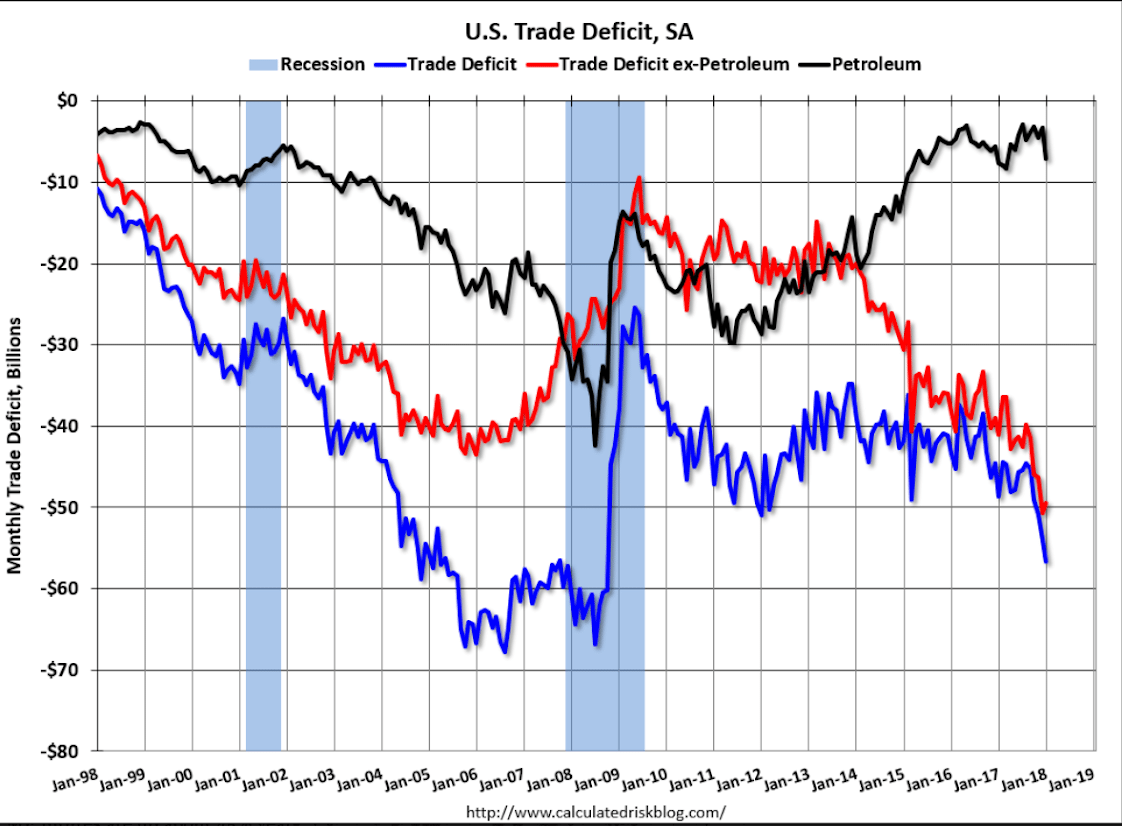
Let’s continue to talk about foreign balance. If we’re running a trade deficit, foreigners are sending us goods and we are sending them dollars. We’re buying their stuff instead of domestic stuff. For that amount of demand, our employment and output is being reduced. So we get underemployment in the U.S. unless we manage to keep domestic demand sufficiently high as we have been doing. When we do that, the notion of comparative advantage is at work and we have a net gain. We’ve been benefiting from this process and should not be fighting imports.

Now remember our identity of the domestic balance is the government plus foreign balances. If we have a 5% foreign trade deficit, but the government is giving us savings with a 5% budget deficit, we’re still only at zero net financial savings. The implication is that now the government can spend a 5% deficit to fully employ our resources without inflation. The government could deficit spend even more to satisfy the desire for positive net financial savings.
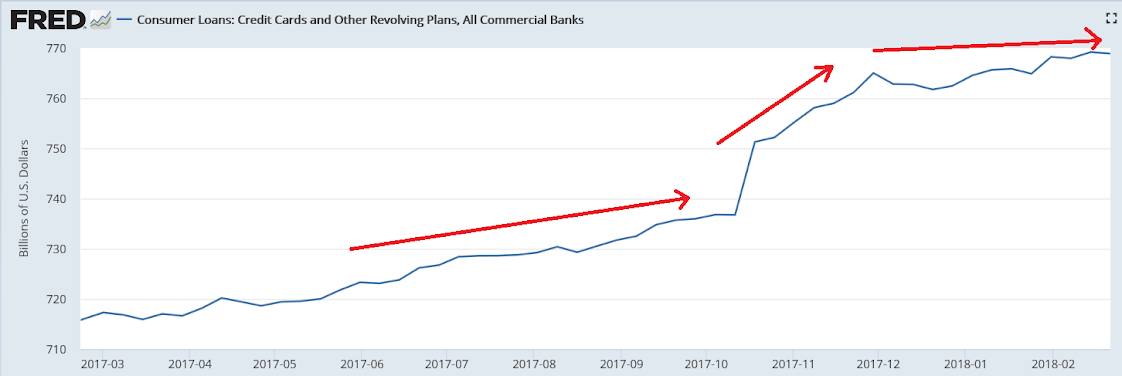
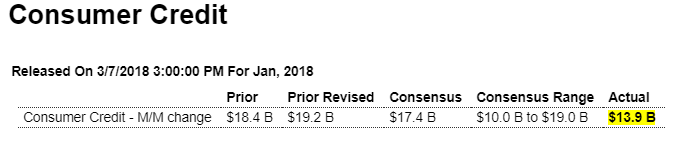
Let’s explore this trade deficit for a little bit. There’ so much talk of how vulnerable we are because foreigners won’t keep financing our foreign trade deficit. There is no such thing as foreigners financing the trade deficit.


“The U.S. is NOT Dependent on Foreign Finance For Our Trade Deficit”

I go to Citibank and I borrow money. My account is credited with 50K in deposits and Citi has an asset of 50K in loans. I take my deposit, buy a car. The foreign seller of the car has the money, first as a deposit at a U.S. bank. Everyone is happy, no imbalances and there is no borrowing of foreign capital. Citibank financed the borrowing for my purchase. The foreigner has dollar savings. Domestic credit creation funds this entire foreign savings, all $700 billion. There is no imported capital to fund the trade gap.

Let’s examine this trade deficit further. The U.S. government is begging China to revalue their currency upwards. Are we nuts? Why do we want to pay more for Chinese goods? Why do we want to give the Chinese a pay raise? We don’t allow our own workers minimum wage raises, and yet we want to give those raises to the Chinese.

They’re selling their goods below fair value which is dumping, and what we know to be an unfair trade. Let’s examine that. Dumping is a political problem, not an economic problem. Let’s put aside the issues of whether they’re incurring pollution costs or other social costs, counterfeiting, patent infringement and the like. Let’s say the Chinese are dumping, selling us goods at 35% of fair value. Here in the U.S. we complain. But what is selling us goods at 35% of fair value? It’s selling us 35 goods at fair value and 65 goods for nothing. There is no way, in the aggregate, that we can be worse off when they take their resources, capital, labor, technology and education and sell us goods for nothing. We are better off. The problem, as I said, is a political problem. Because they sell us goods for nothing, there are workers in the U.S. without incomes. But as we showed before, the U.S. government can now deficit spend so we can get the Chinese goods for nothing, and employ or reemploy these workers in the same, or different areas of the economy, to reestablish employment and aggregate demand without causing inflation.

Just two more comments on the foreign trade balance. We are so worried. We’re worried that they own all these paper assets and might sell them. But let’s think of who is at risk. We have the goods and they have these pieces of paper. They have no idea what those pieces of paper are going to be worth in the future. If they dump dollar assets, the value of their remaining holdings is going to fall dramatically. Who’s at risk? We have the cars, clothes and golf clubs. They have the indeterminate value of the paper.

The conventional wisdom is we want the Chinese and the Japanese to start spending on consumer goods, solve the unsustainable world trade imbalances. I don’t. Who wants to be competing for goods with 1.4 billion Chinese? What will happen to the price of all the items we’re consuming once there is competition for those goods? Nope, I want them to work 16 hours a day, sell us everything we need for nothing, have them never buy anything from anyone, and we play golf all day. The conceptual summation of all this is that exports are a cost and imports a benefit. Think about it.

So let’s conclude with some thoughts about the U.S. economic outlook. My partner Warren Mosler, who focuses on economic analysis and has an exceptional command of these dynamics, has helped offer some of these thoughts about the situation.

The U.S. budget deficit continues to contract. As our little identity equation showed before, the result is that net financial assets are not being added fast enough to support the gross dollars and credit structure, to help both support aggregate demand, and to satisfy the desire for savings engendered by all the incentive savings plans represented by this audience. It calls for budget balancing only making all of this worse.

As such, the financial obligations ratio rises to where the U.S. consumer can no longer continue borrowing at previous growth rates. Allocations to passive commodities by pension and endowment institutions actually exacerbated aggregate demand in the past two years. You are all supposed to buy stocks or bonds, but wound up buying all sorts of commodities. Now this phenomenon is cresting, and should also slow aggregate demand. Exports should be a help as they are picking up, but will probably not accelerate sufficiently to maintain fast GDP growth.

On the inflation front, we still see inflation as a problem despite U.S. economic weakness. It is our view that the Saudis basically set the price of oil and let quantity vary. They are the swing producer. They are comfortable with oil in this price range, so we do not expect price declines. Cost push of these prices is still occurring throughout the U.S. and world economy. Agricultural commodities are now linked to energy sector prices through the biofuels industry and are causing a second wave of food inflation. The Fed is very concerned about inflation, and that’s overall inflation, not just core inflation. If we have 0.2 month to month CPI increases for the balance of the year, YOY headline inflation will be well above 4%. The Fed is adamant about the importance of expectations, and those types of CPI numbers will worry the Fed about losing the 25 years of inflation progress they’ve made. With the labor market still tight, low levels of unemployment and high levels of capacity and resource utilization, the Fed is actually hoping for growth to slow substantially to contain this inflation. It may take much more slowing than that or a significant fall in energy and gasoline prices, for the Fed to ease.

With regard to the all important credit structure, I believe there is a very significant shift underway. In the recent past, lending (gross money) has been made easily available for all sorts of lending, business plans, assets and other leveraged ventures. These gross dollars have fueled both current cyclical economic activity and the rise in dollar asset prices around the world. I believe this is changing through both a repricing of the cost of assuming lending risk, and in a change of the simple willingness to lend or the availability of credit. Remember, loans create all deposits. No loans, no deposit growth. The Fed may be willing to oversee this significant contraction. Why? All of us, and the Fed, watched all these non-regulated lending or investment entities with much higher risk parameters go out and snub their noses at regulated entities and seemingly pass them by in good times. The Fed is not likely to want to provide a safety net and reward them for this type of frowned upon behavior. The Fed will probably be happy to see assets come back to the banking system, under their rules, regulations, and purview. In addition, the Fed will be happy for the greater stability it will bring to the capital structure of the markets and economy because the funding on bank’s balance sheets is anchored by FDIC insured deposits that don’t flee. The U.S. learned this lesson in 1934 with the establishment of deposit insurance to prevent runs on bank funding. The current voluntary termination of lending agreements (loans roll off), or withdrawal of CP deposits, and even withdrawals from hedge funds, highlight the system fragility of highly leveraged enterprises that are subject to liquidity redemptions. The sectors of the market and economy that relied upon these lending and securitization structures for funding will likely suffer, and the lending or credit participants in these sectors will likely be replaced by banks and GSEs.

Fiat currency sovereign issuers are not at risk. However, corporations, municipalities, leveraged loan and investment structures (LBO, private equity), and foreign countries issuing in denominations other than their fiat currency are at risk.

I’ll even present the notion that European government debt is at risk because a strict reading of Maastricht has created municipalities, not sovereigns, without the ECB to provide support. Did you notice that Saachsen Bank had to be bailed out by the German Savings Bank Society?

However, I have one note of caution or caveat to this notion of contraction and rationality. The financial engineering genie is out of the bottle. Financial engineering really began to accelerate when I entered the bond side of the business in the late 1970s with the advent of GNMA futures, Treasury bond and bill futures, currency and stock futures, and then the monumental creation of the interest rate swap, that became the foundation for modern derivatives such as caps, floors, swaptions, total return swaps, all variety of structured notes and even the recent explosion of credit derivatives. These instruments provide the ability to create huge notional exposures, with notional exposures in this credit arena that are hundreds of times the risk in the real economy. IBM used to have 1BB of bonds outstanding. That was the credit risk. Now the credit risk exposure taken by participants can be hundreds or thousands of times the size of the bond issue itself. While the risk may be more diversified or less concentrated, the huge notional size causes great market dislocations. But what I’m saying, is that in cycle after cycle, because it’s so difficult to make real spreads make real returns or real alpha, investors will again seek out the new product, the new leverage, the new derivative (like CDOs, CLOs, CDS) that allow the investor to greatly leverage to seemingly earn superior returns, only to see the eventual risks come to roost and the underlying risks exposed. It will happen again, the form will be different, but it will happen again.

I want to thank everyone for their great courtesy in attending today, and I hope this time together has accomplished something towards my goal, that you won’t be looking at the world economic scene in quite the same way again, and that maybe with a new understanding you’ll be an instrument for positive change in how we should conduct our economic lives.

Thank you very much.


[top]

http://www.moslereconomics.com/wp-content/plugins/sociofluid/images/digg_48.png http://www.moslereconomics.com/wp-content/plugins/sociofluid/images/stumbleupon_48.png http://www.moslereconomics.com/wp-content/plugins/sociofluid/images/delicious_48.png http://www.moslereconomics.com/wp-content/plugins/sociofluid/images/newsvine_48.png http://www.moslereconomics.com/wp-content/plugins/sociofluid/images/technorati_48.png http://www.moslereconomics.com/wp-content/plugins/sociofluid/images/facebook_48.png http://www.moslereconomics.com/wp-content/plugins/sociofluid/images/twitter_48.png

Posted in Currencies, ECB, Inflation, Interest Rates | 6 Comments »

Nikkei News: China exporting inflation to Japan

Posted by WARREN MOSLER on 21st August 2008


[Skip to the end]

Cliff Viner writes:

This is important. We’ve mentioned it before. And although the article is about Japan, it applies to many of China’s other export markets.

Yes, the whole global backdrop shifted from a deflationary to an inflationary bias over the last couple of years.

Also, with all of our outsourcing, these imports costs or some extent replace what was unit labor costs in previous cycle.

So in that sense, labor costs are rising faster than our domestic labor numbers indicate.

China Switches From Deflation Exporter To Inflation Exporter

(Nikkei) The prices of Chinese goods are rising in Japan, with sharp increases hitting anything from clothing to audio equipment. If the rise persists, China, which has long underpinned Japan’s steady price structure with its inexpensive products, could become a factor in lifting Japan’s overall price level.

According to a Bank of Japan check on the July prices of imported products, of which more than 50% are supplied by China, polo shirts and gloves cost some 9% more than in July last year. Pajamas and sweat suits also were up 4%. As made-in-China items make up 80% of Japan’s total clothing imports, higher costs can translate into higher price tags at retailers down the road.

The price rise is not limited to clothing. Imports of toys, of which 90% come from China, shot up 10% in July on the year. The price tags on bags, 50% of which originate in China, also climbed 9%. Of audio and video equipment, with the Chinese import ratio of more than 50%, audio devices increased 3-4%. Among other items, China-made cotton cloth, used mainly for bedding and dress shirts, rose to nine-year highs indicating that rising prices of Chinese imports now run the gamut.

Running to a value of 15 trillion yen in fiscal 2007, Chinese products now account for some 20% of Japan’s total import bills. According to trade statistics compiled by the Ministry of Finance, the price index of Chinese imports, which had been falling, rebounded to positive territory in fiscal 2004 and climbed 7.7% on the year in fiscal 2007 with the uptick still continuing.

Increasing prices of Chinese imports are caused in large part by rising wages in that country. Average wages of China’s urban workers rose 18.7% during 2007 over the previous year. Moreover, labor costs in China are destined to rise further with the passage of the labor contract law in January this year which encourages employers to give employees longer contracts.

The substantial appreciation of the yuan is also to blame for increasing the costs of Chinese imports. The yuan’s value rose 20% against the dollar over the three years since Beijing revalued the currency’s exchange rate in July 2005.

So the Chinese factor is casting increasingly dark shadows over Japan’s price picture. “Attention tends to focus on soaring crude oil prices as the main culprit for the recent bout of inflationary pressure, but nearly 10% of the overall increase in imported products is attributable to the Chinese factor,” said Toshihiro Nagahama, chief economist at Dai-ichi Life Research Institute. This is perhaps why many Bank of Japan economists see China as switching, as far as Japan is concerned, from a deflation exporter to an inflation exporter.


[top]

http://www.moslereconomics.com/wp-content/plugins/sociofluid/images/digg_48.png http://www.moslereconomics.com/wp-content/plugins/sociofluid/images/stumbleupon_48.png http://www.moslereconomics.com/wp-content/plugins/sociofluid/images/delicious_48.png http://www.moslereconomics.com/wp-content/plugins/sociofluid/images/newsvine_48.png http://www.moslereconomics.com/wp-content/plugins/sociofluid/images/technorati_48.png http://www.moslereconomics.com/wp-content/plugins/sociofluid/images/facebook_48.png http://www.moslereconomics.com/wp-content/plugins/sociofluid/images/twitter_48.png

Posted in Articles, China, Exports, Inflation | No Comments »

The 8000lb bear in the room

Posted by WARREN MOSLER on 20th August 2008


[Skip to the end]

There’s nothing credit issues can do to GDP that fiscal policy can’t handle.

Congress has seemingly figured that out and probably the rest of the world as well as evidenced by the new proposed fiscal packages popping up around the world.

Yes, we can lose a bank or two, and lending standards tighten further, but GDP will continue to muddle through even if that means a series of fiscal measures.

And Congress was born to spend; so, they are all over this one.

The only thing that might slow them down is inflation, and so far they’ve seemed to support the Fed trying to step hard on the inflation pedal, rather than ‘tighten’ which presumably helps inflation.

And no one seems to notice the 8000lb bear in the room.

Our response to Russia reminds me of Monty Python’s coconut clapping Arthur trying to intimidate the French defenders of the fort with his credentials.

We threaten them with diplomatic isolation, trade sanctions, etc. as if they care.

They don’t care.

They do care about the new missiles going into Poland.

And we are committed to considering an attack on Poland or any other NATO member as an attack on US soil, as Rice reminded them and even maybe dared them to try something.

We can’t defend anyone against against Russia with our own troops without risking nuclear war.

And Russia will be a lot quicker to that trigger than we will.

And they still have maybe thousands of nuclear warheads aimed our way.

Their next step for Russia is probably to make an offer to the rest of the ex-Soviet Union members they can’t refuse.

Russia sells the Eurozone something like 30% of their oil and gas and can do it at any price they want, and demand any real terms of trade they want.

The risk is we try to draw a line in the sand in some nowhere place over there, and it escalates to where we back down or get involved in lobbing nukes.

I suppose it’s just another case of this administration not seeing the forest for the trees.

We’ve let Russia be reorganized by the ex-KGB leadership that’s a lot smarter than ours, and now we’re paying the price.

Both the inflation and cold war of the 1970s is back, except this time our opposition is far stronger.

There is no even semi-quick supply response to dislodge the Saudis and/or Russians from setting any terms of trade they want.

The Russian consolidation is on the way up supported by a bath of capitalist type riches rather than crumbling under its own weight of a failed socialist economy.

Apart from that, I’m optimistic.


[top]

http://www.moslereconomics.com/wp-content/plugins/sociofluid/images/digg_48.png http://www.moslereconomics.com/wp-content/plugins/sociofluid/images/stumbleupon_48.png http://www.moslereconomics.com/wp-content/plugins/sociofluid/images/delicious_48.png http://www.moslereconomics.com/wp-content/plugins/sociofluid/images/newsvine_48.png http://www.moslereconomics.com/wp-content/plugins/sociofluid/images/technorati_48.png http://www.moslereconomics.com/wp-content/plugins/sociofluid/images/facebook_48.png http://www.moslereconomics.com/wp-content/plugins/sociofluid/images/twitter_48.png

Posted in Fed, Inflation, Russia | 8 Comments »

2008-08-07 UK News Highlights

Posted by WARREN MOSLER on 7th August 2008


[Skip to the end]

Highlights:

ECB Leaves Interest Rates at Seven-Year High to Fight Inflation
German industrial orders drop
Western European Car Sales Fall by 6.7% in July, JD Power Says
German June Exports Rise the Most in Nearly Two Years
German Economy Contracted as Much as 1.5% in 2Q
French Trade Deficit Expands to Record as Euro Curbs Exports
Italian June Production Stalls as Record Oil Prices Damp Growth
Fall in output fuels Spanish recession fears


Article snip:

ECB Leaves Interest Rates at Seven-Year High to Fight Inflation (Bloomberg) - The ECBkept interest rates at a seven-year high to fight inflation even as evidence of an economic slump mounts. ECB policy makers meeting in Frankfurt left the benchmark lending rate at 4.25 %, as predicted by all 60 economists in a Bloomberg News survey. The bank, which raised rates last month, will wait until the second quarter of next year to cut borrowing costs, a separate survey shows. The ECB is concerned that the fastest inflation in 16 years will help unions push through demands for higher wages and prompt companies to lift prices. At the same time, record energy costs and the stronger euro are strangling growth. Economic confidence dropped the most since the Sept. 11 terrorist attacks in July and Europe’s manufacturing and service industries contracted for a second month. ECB President Jean-Claude Trichet will hold a press conference 2:30 p.m. to explain today’s decision.

Same as UK, less costly to address inflation now rather than support growth and address inflation later if it gets worse.

It’s been said in the US that the Fed needs to firm up the economy first, and then address inflation. To most Central Bankers this makes no sense, as they use weakness to bring inflation down.

In their view that means the Fed wants to get the economy strong enough to then weaken it.

The Fed majority sees it differently.

They agree with the above.

However, for the last year they have been forecasting lower inflation and lower growth were willing to take the chance that supporting growth would not result in higher inflation.

Now, a year later, the FOMC is faced with higher inflation and more growth than the UK and Eurozone, and systemic ‘market functioning’ risk remains.

The FOMC continues to give the latter priority as they struggle with fundamental liquidity issues that stem from a continuing lack of understanding of monetary operations.


[top]

http://www.moslereconomics.com/wp-content/plugins/sociofluid/images/digg_48.png http://www.moslereconomics.com/wp-content/plugins/sociofluid/images/stumbleupon_48.png http://www.moslereconomics.com/wp-content/plugins/sociofluid/images/delicious_48.png http://www.moslereconomics.com/wp-content/plugins/sociofluid/images/newsvine_48.png http://www.moslereconomics.com/wp-content/plugins/sociofluid/images/technorati_48.png http://www.moslereconomics.com/wp-content/plugins/sociofluid/images/facebook_48.png http://www.moslereconomics.com/wp-content/plugins/sociofluid/images/twitter_48.png

Posted in Articles, CBs, Inflation, Interest Rates, UK | No Comments »

TimesOnline: Latest on BoE rate setting

Posted by WARREN MOSLER on 7th August 2008

The mainstream view remains the cost of a near term recession in order to bring prices under control now is far less than the cost of a recession later if you support growth now and let prices continue higher.

Bank of England holds interest rate at 5%

by Gary Duncan, Grainne Gilmore

The Bank of England rebuffed mounting concerns over the rapidly weakening economy today and held interest rates at 5 per cent as it pursued its drive to quell soaring inflation.

The tough verdict from the Bank’s rate-setting Monetary Policy Committee (MPC) brushed aside pleas from business leaders and trade unions for a cut in base rates to shore up Britain’s growth, amid growing fears that the country is on the brink of recession.

The Bank’s decision came after headline consumer price inflation leapt to a 10-year high of 3.8 per cent in June, well above the Bank’s 2 per cent target, and amid expectations that it could hit 5 per cent over the summer, following swingeing increases in household gas and electricity bills imposed by utility companies.

The MPC had been widely expected to spurn pressure for a rate cut today in a bid to make clear its determination to bring inflation back to the target set by the Chancellor. The committee will almost certainly have discussed raising rates this morning, as it did last month, when Professor Tim Besley, voted for an immediate increase. He is expected to have done so again today, and may have been joined by other hawkish MPC members.

The Bank will set out its thinking more clearly next week when it publishes its latest forecasts for the economy in its quarterly Inflation Report. That is expected to emphasise the dilemma that the MPC confronts, with inflation set to soar far above target in the next few months, even as the economy slides towards a severe downturn.

The quandary facing the Bank was underlined yesterday as the International Monetary Fund sharply cut its forecasts for Britain’s growth this year and next, while issuing a warning that it saw “little scope” for interest rates to fall, although it also saw no need for an immediate rate rise.

Today’s no-change verdict by the MPC came despite bleak economic news in recent days, which have produced danger signs of recession.

Concern that Britain’s growth had ground to a virtual halt last month, and could even be in the grip of recession, were inflamed this week after bleak figures revealed growing frailty in the most critical parts of the economy.

These included shrinking activity in the services sector, the economy’s engine room that account for three quarters of the UK’s output, as well as in manufacturing.

The services sector, spanning businesses from cafes and leisure centres to accountancy and law firms, shrank for a third month in succession last month, according to the latest purchasing managers’ survey, regarded by the Bank as a key gauge of economic conditions.

Although services activity edged up from a seven-year low that was plumbed in June, the survey pointed to an even sharper slowdown ahead, with levels of outstanding business for the sector’s companies falling for a tenth month in a row, and inflows of new business dropping to a record low.

At the same time, it emerged that manufacturing is suffering its first sustained run of decline since 2001, after its output fell in June for a fourth month in a row, dropping by 0.5 per cent.

The figures were among the latest data confirming the dire plight of the economy, and came after official confirmation that the pace of Britain’s overall growth slowed to just 0.2 per cent in the second quarter, its weakest rate of expansion for three years.

The falling housing market remains a key source of economic anxiety, with the Nationwide Building Society reporting that house prices tumbled by a further 1.7 per cent last month, leaving them down 8.1 per cent on last year - their sharpest annual pace of decline since 1991.

The high street is also being badly hit by the downturn, with official figures showing that retail sales plunged by 3.9 per cent in June - their biggest monthly drop for 22 years.

Yesterday, the International Monetary Fund added to the mood of pessimism as it cut its forecast for Britain’s growth this year and next to only 1.4 per cent, and 1.1 per cent, respectively. The prediction of the UK’s worst performance since the end of the last recession raised the spectre of two years of economic misery.

In May, Mervyn King, Governor of the Bank, was forced to write an explanatory letter to the Chancellor, required by law, explaining why inflation had risen more than 1 point above its 2 per cent target, after it climbed to its then-high of 3.3 per cent. Mr King has admitted that he expects to write more such letters this year.

The Bank’s inflation headache has been further aggravated by signs of further severe price pressures in the pipeline to the consumer, Manufacturers’ costs rose at a record 30 per cent annual rate in June, and prices for goods leaving factories rose by a record 10 per cent. Inflation is being stoked by a sharp slide in the pound, by about 12 per cent over the past year, which lifts Britain’s bills for imported products.

However, there has been some let up in international food and energy costs, with oil prices tumbling by 13 per cent in a month, and prices for food products are also on the slide.

http://www.moslereconomics.com/wp-content/plugins/sociofluid/images/digg_48.png http://www.moslereconomics.com/wp-content/plugins/sociofluid/images/stumbleupon_48.png http://www.moslereconomics.com/wp-content/plugins/sociofluid/images/delicious_48.png http://www.moslereconomics.com/wp-content/plugins/sociofluid/images/newsvine_48.png http://www.moslereconomics.com/wp-content/plugins/sociofluid/images/technorati_48.png http://www.moslereconomics.com/wp-content/plugins/sociofluid/images/facebook_48.png http://www.moslereconomics.com/wp-content/plugins/sociofluid/images/twitter_48.png

Posted in Articles, Energy, Inflation, Interest Rates, UK | No Comments »

Re: UK economy

Posted by WARREN MOSLER on 6th August 2008


[Skip to the end]

(an email exchange)

>   
>   
>   On Wed, Aug 6, 2008 at 12:25 AM, Prof. P. Arestis wrote:
>   
>   Dear Warren,
>   
>   Just received the piece below. The situation over here is getting
>   worse but pretty much as expected.
>   
>   Recession signalled by key indicators of British economy
>   
>   
>   Best wishes, Philip
>   

Dear Philip,

Yes, seems tight fiscal has finally taken its toll and is now reversing the ugly way - falling revenues and rising transfer payments.

Without support from government deficit spending, consumer debt increases sufficient to support modest growth are unsustainable.

And with a foreign monopolist setting crude oil prices ‘inflation’ will persist until there is a large enough supply response,

It’s the BoE’s choice which to respond to, though ironically changing interest rates is for the most part ceremonial.

All the best,
Warren


[top]

http://www.moslereconomics.com/wp-content/plugins/sociofluid/images/digg_48.png http://www.moslereconomics.com/wp-content/plugins/sociofluid/images/stumbleupon_48.png http://www.moslereconomics.com/wp-content/plugins/sociofluid/images/delicious_48.png http://www.moslereconomics.com/wp-content/plugins/sociofluid/images/newsvine_48.png http://www.moslereconomics.com/wp-content/plugins/sociofluid/images/technorati_48.png http://www.moslereconomics.com/wp-content/plugins/sociofluid/images/facebook_48.png http://www.moslereconomics.com/wp-content/plugins/sociofluid/images/twitter_48.png

Posted in Articles, CBs, Inflation, Interest Rates, Oil, UK | 4 Comments »

Fed Governor Mishkin on monetary policy

Posted by WARREN MOSLER on 29th July 2008


[Skip to the end]

In case there was any doubt things have changed.

from his July 28 speech:

Policymakers, academic economists, and the general public broadly agree that maintaining a low and stable inflation rate significantly benefits the economy. For example, low and predictable inflation simplifies the savings and retirement planning of households, facilitates firms’ production and investment decisions, and minimizes distortions that arise because the tax system is not completely indexed to inflation. Moreover, I interpret the available economic theory and empirical evidence as indicating that a long-run average inflation rate of about 2 percent, or perhaps a bit lower, is low enough to facilitate the everyday decisions of households and businesses while also alleviating the risk of debt deflation and other pitfalls of excessively low inflation.

The rationale for promoting maximum sustainable employment is also fairly obvious: Recessions weaken household income and business production, and unemployment hurts workers and their families.

No mention of lost real output. Must have been an oversight.

As I have outlined elsewhere, these two objectives are typically complementary and mutually reinforcing: that is, done properly, stabilizing inflation contributes to stabilizing economic activity around its sustainable level, and vice versa.

Hence the dual mandate is met by sustaining low and stable inflation rates.

Nevertheless, it’s important to note a fundamental difference between the objectives of price stability and maximum sustainable employment. On the one hand, the long-run average rate of inflation is solely determined by the actions of the Federal Reserve.

And they do believe that. They believe it’s all a function of the interest rates they select.

On the other hand, the level of maximum sustainable employment is not something that can be chosen by the Federal Reserve, because no central bank can control the level of real economic activity or employment over the longer run.

And they are not responsible for the level of economic activity, only the rate of inflation.

In fact, any attempt to use stimulative monetary policy to maintain employment above its long-run sustainable level would inevitably lead to an upward spiral of inflation with severe adverse consequences for household income and employment.


[top]

http://www.moslereconomics.com/wp-content/plugins/sociofluid/images/digg_48.png http://www.moslereconomics.com/wp-content/plugins/sociofluid/images/stumbleupon_48.png http://www.moslereconomics.com/wp-content/plugins/sociofluid/images/delicious_48.png http://www.moslereconomics.com/wp-content/plugins/sociofluid/images/newsvine_48.png http://www.moslereconomics.com/wp-content/plugins/sociofluid/images/technorati_48.png http://www.moslereconomics.com/wp-content/plugins/sociofluid/images/facebook_48.png http://www.moslereconomics.com/wp-content/plugins/sociofluid/images/twitter_48.png

Posted in Fed, Inflation | No Comments »

AP: Rising inflation hits German confidence

Posted by WARREN MOSLER on 28th July 2008

Rising inflation hits German confidence

by Matt Moore

Same theme: ‘inflation’ hurting buying plans.

Expectations theory says ‘inflation’ expectations will accelerate purchases.

Different kinds of ‘inflation’ at work…

http://www.moslereconomics.com/wp-content/plugins/sociofluid/images/digg_48.png http://www.moslereconomics.com/wp-content/plugins/sociofluid/images/stumbleupon_48.png http://www.moslereconomics.com/wp-content/plugins/sociofluid/images/delicious_48.png http://www.moslereconomics.com/wp-content/plugins/sociofluid/images/newsvine_48.png http://www.moslereconomics.com/wp-content/plugins/sociofluid/images/technorati_48.png http://www.moslereconomics.com/wp-content/plugins/sociofluid/images/facebook_48.png http://www.moslereconomics.com/wp-content/plugins/sociofluid/images/twitter_48.png

Posted in Inflation | No Comments »

2008-07-28 UK News Highlights

Posted by WARREN MOSLER on 28th July 2008


[Skip to the end]

Highlights:

U.K. Hometrack House Prices Fall the Most Since 2001
Brown Says He Won’t Turn to ’70s Agenda After Defeat
Darling Considers Expanding Mortgage Bond-Swap Scheme, FT Says


U.K. Hometrack House Prices Fall the Most Since 2001

by Brian Swint

(Bloomberg) The average cost of a residential property in England and Wales slipped 4.4 % in July from a year earlier to 168,500 pounds ($336,000), Hometrack Ltd. said. Prices fell 1.2 % from June. “With no immediate end in sight to the current uncertainty, activity levels are likely to remain suppressed with prices remaining under pressure into the autumn,” said Richard Donnell, director of research at Hometrack. Prices “are now back to levels last seen in October 2006.” Demand for housing has declined 20 % in the past three months, Hometrack said.

Note how much higher prices are vs the US.

It’s another case of going up very fast and now working its way down towards a more historically normal trend line.

But as in the US, they never come down quite that far before turning up on a new path from a higher base as much of past ‘inflation’ remains indefinitely.


[top]

http://www.moslereconomics.com/wp-content/plugins/sociofluid/images/digg_48.png http://www.moslereconomics.com/wp-content/plugins/sociofluid/images/stumbleupon_48.png http://www.moslereconomics.com/wp-content/plugins/sociofluid/images/delicious_48.png http://www.moslereconomics.com/wp-content/plugins/sociofluid/images/newsvine_48.png http://www.moslereconomics.com/wp-content/plugins/sociofluid/images/technorati_48.png http://www.moslereconomics.com/wp-content/plugins/sociofluid/images/facebook_48.png http://www.moslereconomics.com/wp-content/plugins/sociofluid/images/twitter_48.png

Posted in Housing, Inflation, UK | 4 Comments »