Fed Governor Mishkin on monetary policy


[Skip to the end]

In case there was any doubt things have changed.

from his July 28 speech:

Policymakers, academic economists, and the general public broadly agree that maintaining a low and stable inflation rate significantly benefits the economy. For example, low and predictable inflation simplifies the savings and retirement planning of households, facilitates firms’ production and investment decisions, and minimizes distortions that arise because the tax system is not completely indexed to inflation. Moreover, I interpret the available economic theory and empirical evidence as indicating that a long-run average inflation rate of about 2 percent, or perhaps a bit lower, is low enough to facilitate the everyday decisions of households and businesses while also alleviating the risk of debt deflation and other pitfalls of excessively low inflation.

The rationale for promoting maximum sustainable employment is also fairly obvious: Recessions weaken household income and business production, and unemployment hurts workers and their families.

No mention of lost real output. Must have been an oversight.

As I have outlined elsewhere, these two objectives are typically complementary and mutually reinforcing: that is, done properly, stabilizing inflation contributes to stabilizing economic activity around its sustainable level, and vice versa.

Hence the dual mandate is met by sustaining low and stable inflation rates.

Nevertheless, it’s important to note a fundamental difference between the objectives of price stability and maximum sustainable employment. On the one hand, the long-run average rate of inflation is solely determined by the actions of the Federal Reserve.

And they do believe that. They believe it’s all a function of the interest rates they select.

On the other hand, the level of maximum sustainable employment is not something that can be chosen by the Federal Reserve, because no central bank can control the level of real economic activity or employment over the longer run.

And they are not responsible for the level of economic activity, only the rate of inflation.

In fact, any attempt to use stimulative monetary policy to maintain employment above its long-run sustainable level would inevitably lead to an upward spiral of inflation with severe adverse consequences for household income and employment.


[top]
Re: Fed study on TAF


[Skip to the end]

>    
>    On Tue, Jul 29, 2008 at 4:05 AM, Andrea wrote:
>    
>    In case you haven’t seen this yet: A Fed study that finds that
>    Taf has lowered Libor.
>    
>    http://www.newyorkfed.org/research/staff_reports/sr335.html
>    
>    

right, thanks, as if they needed to fund a study to figure that out!

It’s like doing a study that shows the repo rate goes down when the fed lowers its ‘stop’ on repo.

(Too bad they didn’t use this study to show they should set a rate for the TAF and let quantity float, instead of setting a quantity and having an auction.)

It’s this kind of expense that gives govt. a govt. spending negative connotation.

all the best!

warren


[top]

2008-07-29 US Economic Releases


[Skip to the end]


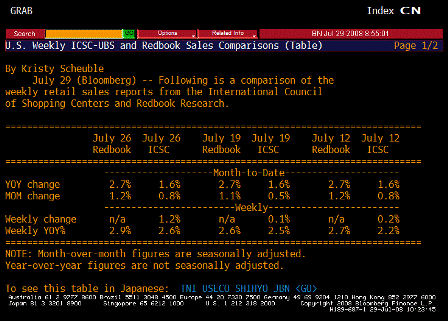
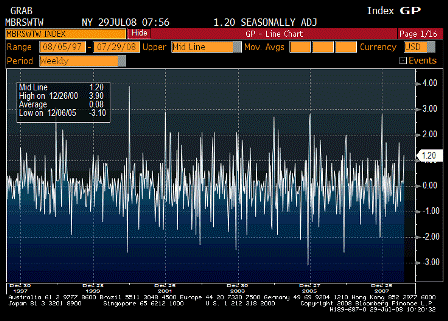
ICSC-UBS Store Sales WoW (Jul 29)

Survey n/a
Actual 1.2%
Prior 0.1%
Revised n/a

[top][end]

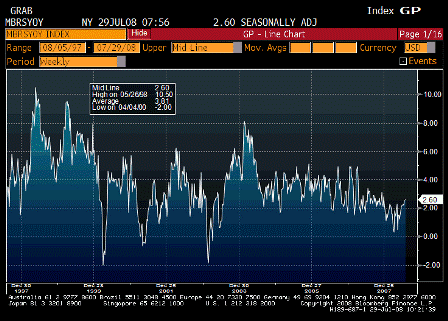
ICSC-UBS Store Sales YoY (Jul 29)

Survey n/a
Actual 2.6%
Prior 2.5%
Revised n/a

Still inching higher.

[top][end]

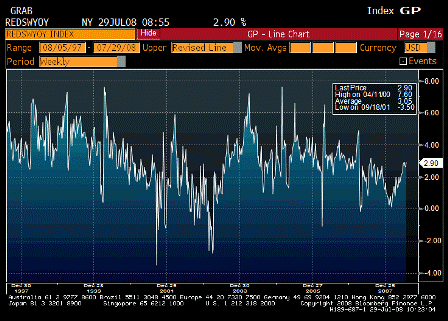
Redbook Store Sales Weekly YoY (Jul 29)

Survey n/a
Actual 2.9%
Prior 2.6%
Revised n/a

No let up here yet either.

[top][end]

ICSC-UBS Redbook Comparison TABLE (Jul 29)

[top][end]


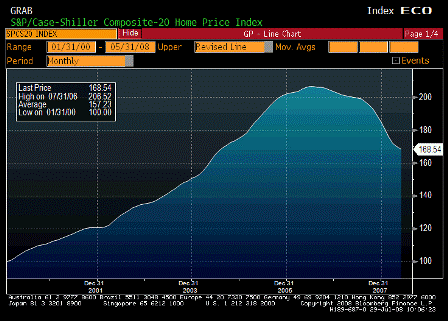
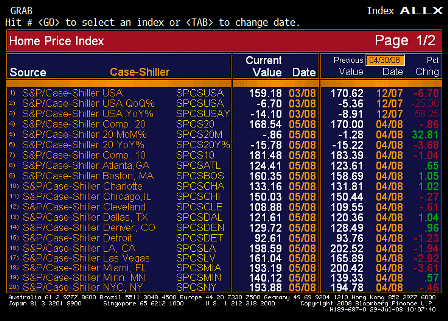
S&P-Case Shiller Home Price Index (May)

Survey n/a
Actual 168.54
Prior 169.85
Revised 170.00

[top][end]

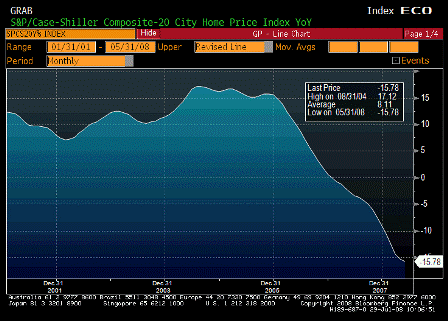
S&P-CS Composite-20 YoY (May)

Survey -16.00%
Actual -15.78%
Prior -15.30%
Revised -15.22%

[top][end]

Case Shiller ALLX 1 (May)

[top][end]

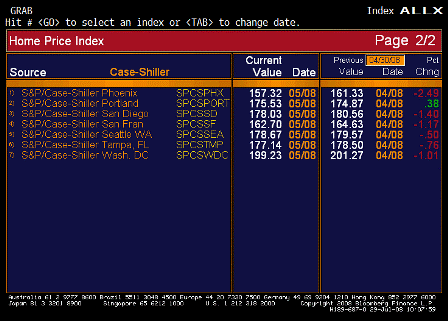
Case Shiller ALLX 2 (May)

Still declining but the rate of decline is quickly diminishing,

In line with other housing indicators that are appear to have bottomed.

[top][end]


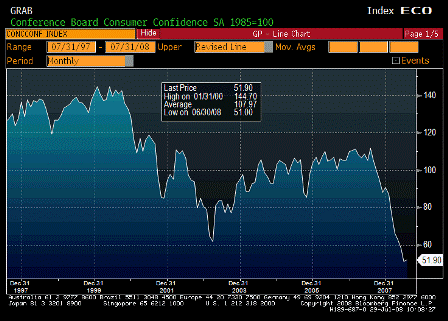
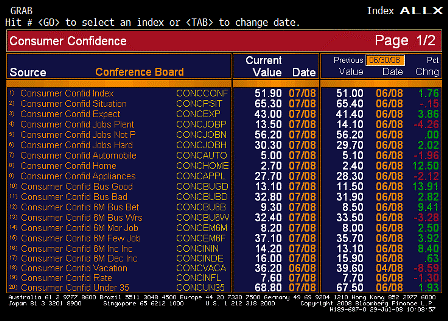
Consumer Confidence (Jul)

Survey 50.1
Actual 51.9
Prior 50.4
Revised 51.0

[top][end]

Consumer Confidence ALLX 1 (Jul)

[top][end]

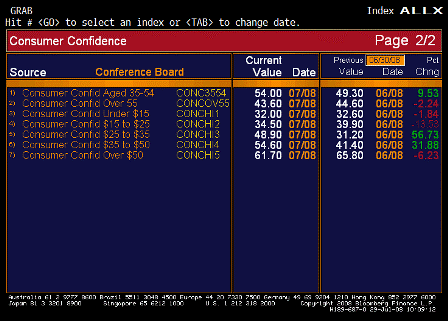
Consumer Confidence ALLX 2 (Jul)

Survey
Actual
Prior
Revised

Karim writes:

  • Headline confidence rises from 51 to 51.9 (first gain since Dec)
  • Jobs Plentiful less jobs hard to get falls from -15.6 to -16.8 (new cycle low); with initial claims back above 400k now, payrolls on Friday have downside risk to -75k consensus. As important, increasing jobs hard to get is correlated to increasing duration of unemployment.
  • Plans to buy an auto fall to new cycle low of 5.0 from 5.1
  • Plans to buy a home increases from cycle low of 2.4 to 2.7
  • Plans to buy a major appliance fall to new cycle low of 27.7 from 28.3

[top][end]


ABC Consumer Confidence (Jul 27)

Survey
Actual
Prior -41
Revised

[top][end]

ABC Consumer Confidence ALLX (Jul 27)


[top]