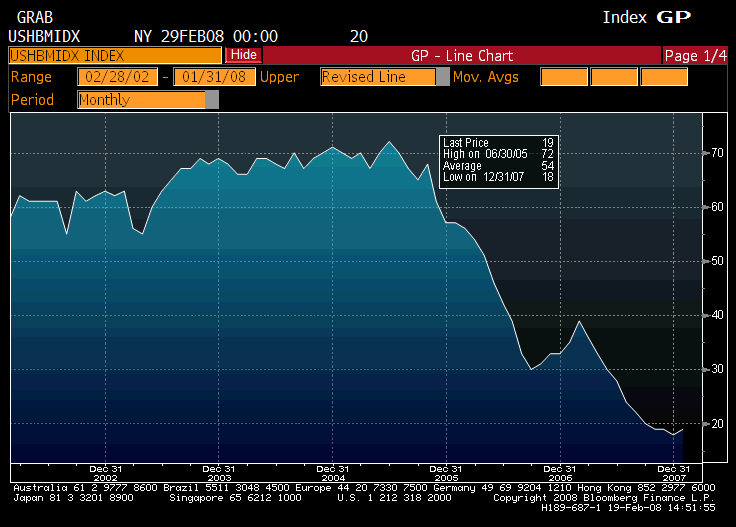
NAHB Housing Market Index (Feb)
| Survey | 19 |
| Actual | 20 |
| Prior | 19 |
| Revised | – |
Still a possible bottom forming.
Coming out later today..
ABC Consumer Confidence (Feb 17)
| Survey | -37 |
| Actual | — |
| Prior | -37 |
| Revised | — |
[comments]

| Survey | 19 |
| Actual | 20 |
| Prior | 19 |
| Revised | – |
Still a possible bottom forming.
Coming out later today..
| Survey | -37 |
| Actual | — |
| Prior | -37 |
| Revised | — |
[comments]
(an email)
> On Feb 19, 2008 10:03 AM, Mike wrote:
> Warren, note spec comments and dollar issues, a big hurdle to overcome
> if they go the other way …
> Mike
Hi Mike,
Agreed the dollar may have bottomed. Seems to have reached a level where exports are now growing at about 13% which maybe is the right number to accommodate the pressure from the non resident sector to slow it’s accumulation of $US financial assets.
However I continue to conclude the price of crude is being set by the Saudi’s/Russians acting as swing producer, and that there is sufficient demand to keep them in the driver’s seat. Quantity pumped keeps creeping up at current prices, with Saudis last reporting 9.2 million bpd output.
Crude at 98.70 now. Note crude goes up on news a refinery is down, when refineries are the only buyers of crude, so in fact it’s going up for other reasons (price setting by the swing producer?). Also, WTI is now ahead of Brent, indicating whatever was causing the sag in WTI vs Brent is over. WTI would ordinarily trade higher than Brent due to shipping charges.
Warren
Interesting they would take a shot like that at the Fed. Probably concerned about Euro strength and the US gaining export share.
Bank of France Says Fed Overreacted to Market Decline
By Francois de Beaupuy
(Bloomberg) The Bank of France said the U.S. Federal Reserve may have cut interest rates too much and too quickly in response to financial-market declines.
An unsigned article in the Paris-based bank’s monthly bulletin, published today, said new financial products have amplified asset price swings.
That may lead to “stronger monetary reactions than what would otherwise be necessary, as shown by the recent decision of the Federal Reserve,” the article said.
The unusual criticism by one central bank of another may reflect the European Central Bank’s reluctance to follow its U.S. and U.K. counterparts in cutting rates to cushion against an economic slowdown. The ECB left its benchmark rate at 4 percent this month even as growth prospects deteriorate.
“The Bank of France is simply going along the ECB line, trying to manage expectations away from any response similar to the Fed,” said Gareth Claase, an economist at Royal Bank of Scotland Plc in London. “The Fed moved quickly and far. The ECB is likely to move slowly and little.”
The Fed has lowered its benchmark rate by 2.25 percentage points since September to 3 percent — including a three-quarter point emergency cut on Jan 22 — and traders expect another reduction next month.
‘Unusually High’
German Finance Minister Peer Steinbrueck said Feb. 12 he didn’t see ECB Bank President Jean-Claude Trichet shifting to a neutral stance, which might be a prelude to cutting rates. At a press conference last week, Trichet said uncertainty about growth prospects is “unusually high,” prompting traders to raise bets on a rate cut.
“Pressure on the ECB increased after the massive Fed rate cuts,” said Michael Schubert, an economist at Commerzbank AG in Frankfurt. “The ECB has said that it won’t act anytime soon. It doesn’t want to be driven by the Fed.”
German investor confidence unexpectedly increased this month, a sign the European economy can weather the U.S. slowdown.
“It’s unusual for central banks to criticize the actions of others,” said Dominic Bryant, an economist at BNP Paribas in London. “The U.S. is in recession, so it’s somewhat difficult to say the Fed overreacted.”
♥
Might be a revealing day coming up.
I’m watching for markets to begin to link higher oil prices to the potential for higher interest rates, rather than the reverse as has been the case since August.
With oil up to the mid 97 range this am, the question is whether short term interest rates move higher due to possible Fed concerns about inflation, even with weak growth and continuing financial sector issues. Even Yellen recently voiced concerns about energy prices now feeding into core inflation measures which are now above her ‘comfort zone.’ And Friday Mishkin said more than once in a short speech that the Fed had to be prepared to reverse course if inflation expectations elevate.
Yes, credit spreads are a lot wider, but when, for example, I ask the desk if any of the wider AAA’s are ultimately money good, I get a lot of uncertainty. So it seems to me in many cases markets are functioning to price risk at perceived potential default levels? So some of the current spreads may be wider than they ‘should be’ but maybe not all that much?
Yes, the financial sector has been damaged (and damnaged).
Yes, housing is weak without the bid for subprime housing of 18 months ago.
And yes, the consumer has slowed down some.
However, exports are booming like a third world country- growing around 13% per year, also do to financial market shifts, this time away from $US financial assets.
This is offsetting weakening domestic demand and keeping gdp positive, at least so far.
Meanwhile, it looks like a full blow 1970’s inflation in the making if food, fuel, and import/export prices keep doing what they are doing.
And with Saudi production continuing to creep up at current pricing, seems demand is more than strong enough for them to keep hiking prices.
And suddenly Yellen and Mishkin, both doves, substantially elevate their anti inflation rhetoric, as core levels have gone just beyond even their comfort zones.