SF Fed president Yellen on inflation, from yesterday’s speech in Hawaii:
Now let me turn to inflation. The recent news has been disappointing. Over the past three months, the personal consumption expenditures price index excluding food and energy, or the core PCE price indexâ€â€Âone of the key measures included in the FOMC’s quarterly forecastsâ€â€Âhas increased by 2.7 percent, bringing the increase over the past 12 months to 2.2 percent. This rate is somewhat above what I consider to be price stability.
Yellen is the most dovish Fed president and not currently a voting member. Notable that 2.2% core PCE is clearly above her comfort zone.
I expect core inflation to moderate over the next few years, edging down to around 1¾ percent under appropriate monetary policy.
Appropriate monetary policy is a requirement to bring inflation down.
Such an outcome is broadly consistent with my interpretation of the Fed’s price stability mandate. Moreover, I believe the risks on the upside and downside are roughly balanced. First, it appears that core inflation has been pushed up somewhat by the pass-through
Up until now, the Fed has taken comfort that ‘pass through’ was not happening. This is what brings core up to headline, something the Fed has previously believed was not happening.
of higher energy and food prices and by the drop in the dollar. However, recently, energy prices have turned down in response to concerns that a slowdown in the U.S. will weaken economic growth around the world, and thereby lower the demand for energy.
Meaning an upturn in energy prices will do the reverse. Seems inflation is now a function of energy prices. This is a change from energy prices weakening demand and causing deflation. Now, it is passing through and causing core inflation.
Another factor that could restrain inflationary pressures is the slowdown in the U.S. economy. This can be expected to create more slack in labor and goods markets, a development that typically has been associated with reduced inflation in the past.
Yes. This is the remaining dove position. Previous speeches this week by the hawks have expressed concerns that economic weakness and slack in the labor markets will not bring down core inflation.
This is the problem of the trade-off between unemployment and inflation. Seems that the applicable historical data now shows that it takes ever larger moves in unemployment to move the inflation needle in either direction.
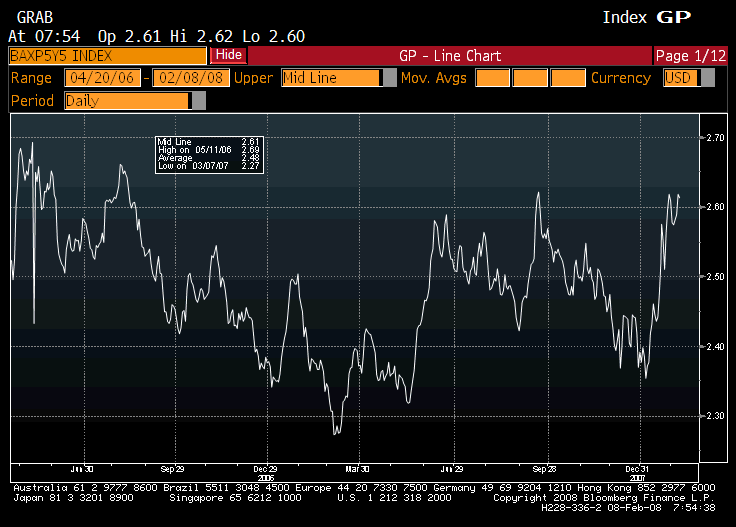
A key factor for inflation going forward is inflation expectations. These appear to have become well-anchored over the past decade or so as the Fed’s inflation resolve has gained credibility. Very recently, far-dated inflation compensationâ€â€Âa measure derived from various Treasury yieldsâ€â€Âhas risen, but it’s not clear whether this rise is due to higher inflation expectations or to changes in the liquidity of those Treasury instruments or inflation risk. Going forward, we will need to monitor inflation expectations carefully to ensure that they do indeed remain well anchored.
All speeches have now stated that there are signs inflation expectations may be elevating.
There are two schools of thought on this at the Fed. The majority will state that when expectations begin to rise, it is too late. The minority say you can let them rise a ‘little bit’, but then they must take decisive action.
Since August, the Fed forecasts have been projecting that economic weakness will bring down prices. With both hawks and doves now acknowledging that this my not be the case, it could be the official Fed forecasts have elevated their near- and medium-term inflation forecasts.
The long-term Fed inflation forecast will remain the same, as it indicates what their long-term inflation target is. But also in the forecasts is what Yellen called the ‘appropriate monetary policy’ to achieve that target.
This could mean the official forecasts now have higher interest rates built into their forecasting model.
And more so now that Congress passed the fiscal package today. Private forecasts are saying it will add maybe 1% of GDP by Q2 and may double that in Q3. At a minimum, this will help support domestic gasoline demand. (And raising the mortgage cap won’t hurt either.)
My twin themes that began in Q2 2006 remain:
- Weakening domestic demand due to the government deficit being too small, but supported by strong exports due to non-residents’ reduced desire to accumulate $US financial assets and now some additional support to demand from today’s fiscal package.
- Rising prices are due to Saudis/Russians acting as swing producer and setting price at ever higher levels until demand falls below their pain thresholds.
For the last five months, I have been underestimating the Fed’s inflation tolerance. They all firmly believe that price stability is a necessary condition for optimal long-term growth and employment.
And they all do not want a relative-value story to turn into an inflation story as happened in the 1970s.
The Fed is data dependent; the question is which data.
At some point, it becomes the inflation data, and at that point, the Fed is way behind the inflation curve.
For example, rates are up to 7.25% in Australia and their inflation is 1% lower than ours.
Bernanke spends next week. The fixed exchange rate types of deflationary risks he has feared have not materialized.
It is looking more like the 1970s than the 1930s.
If Bernanke confirms inflation expectations have been elevating, the easing cycle may be over.
No matter how weak the economy may get in the near term.
♥