The Center of the Universe

Saint Croix, United States Virgin Islands

Archive for February, 2008

2008-02-29 US Economic Releases

Posted by WARREN MOSLER on 29th February 2008

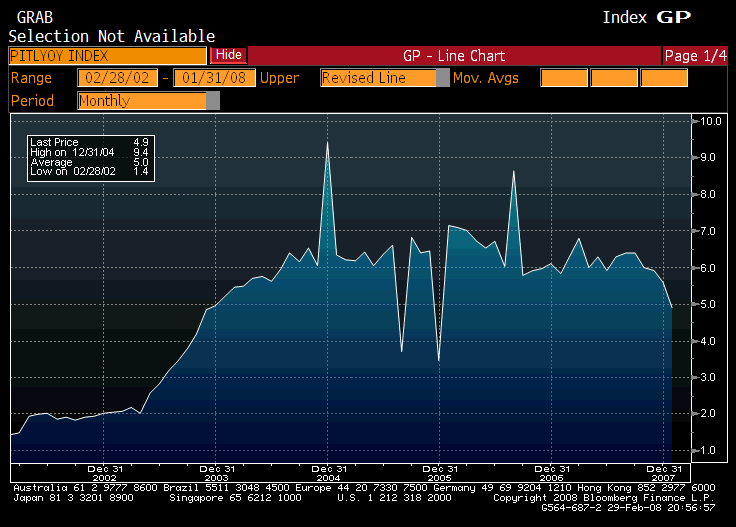
2008-02-29 Personal Income YoY

Personal Income YoY (Jan)

Survey n/a
Actual 4.9
Prior 5.6
Revised n/a

Falling off some. Interest rates are partially responsible, as last I checked households are still net savers and have net interest income.

This is one reason I lean towards the view that lower interest rates tend to slow nominal growth, while higher interest rates support nominal growth.
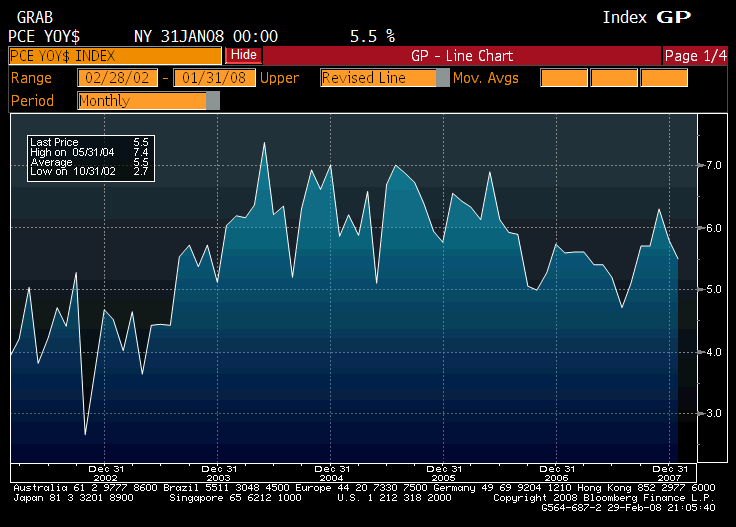

2008-02-29 Personal Consumption Expense Nom$ YoY

Personal Expenditures Nominal$ YoY (Jan)

Survey n/a
Actual 5.5%
Prior 5.8%
Revised n/a

Nominal spending holding up. With our ‘new’ export economy, real spending gives way to exports, and GDP muddles through.
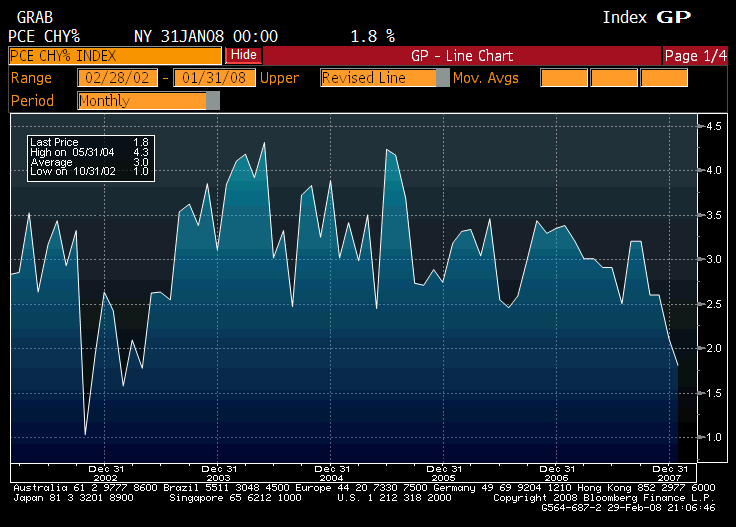

2008-02-29 Personal Consumption Expenditures Chain YoY

Personal Expenditures Chain YoY (Jan)

Survey n/a
Actual 1.8%
Prior 2.1%
Revised n/a

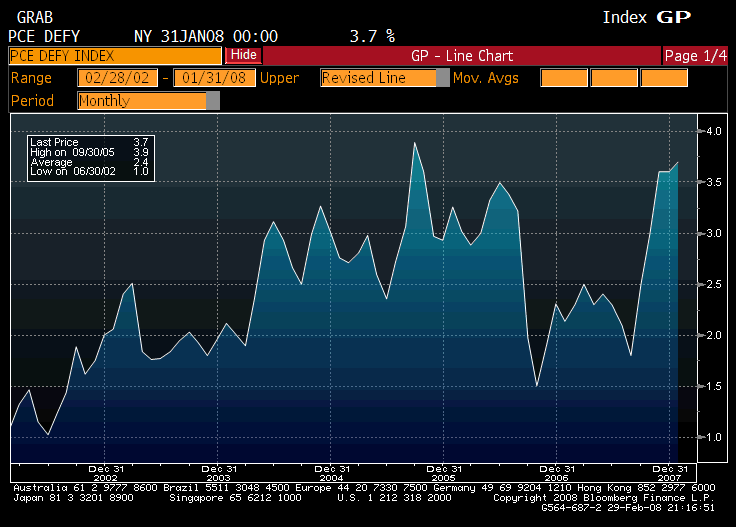
2008-02-29 Personal Consumption Expenditures Price YoY

Personal Expenditure Price YoY (Jan)

Survey n/a
Actual 3.7%
Prior 3.6%
Revised n/a

This is problematic for the Fed.


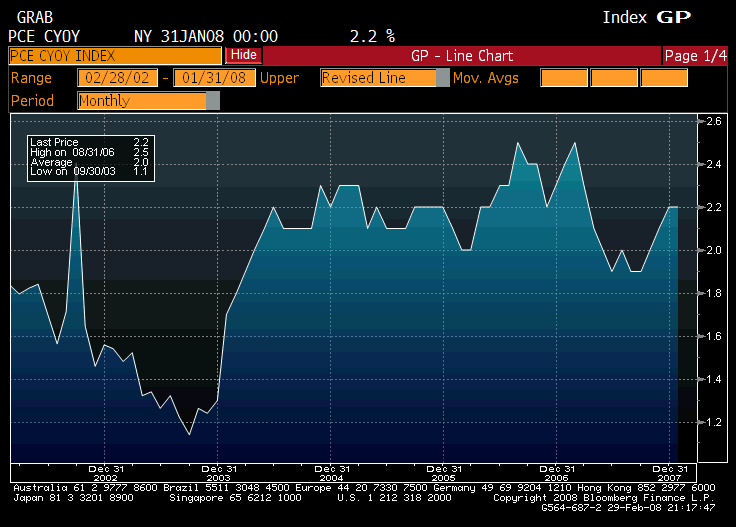
2008-02-29 Personal Consumption Expenditures Core YoY

Personal Expenditure Core YoY (Jan)

Survey n/a
Actual 2.2%
Prior 2.2%
Revised n/a

This is not easy for the Fed to watch, as they worked long and hard to bring it below 2% and back to their comfort zone of 1-2%. Now the concern is how hard it will be to bring down from even higher expected levels if they keep cutting rates.
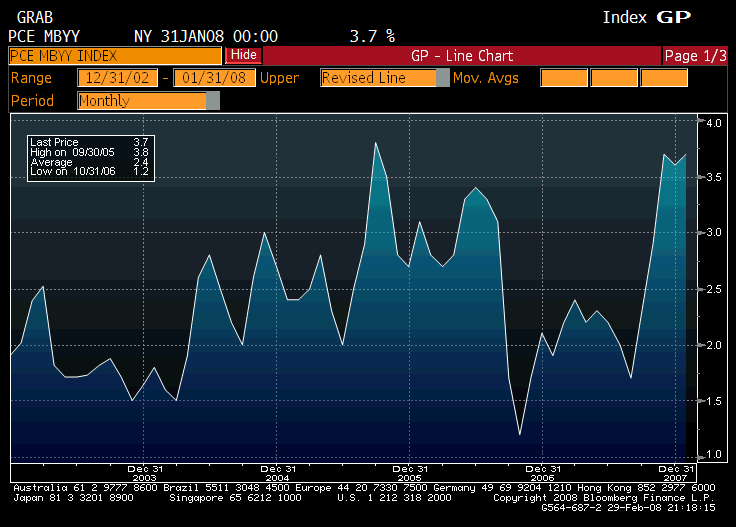

2008-02-29 Personal Consumption Market Based YoY

Personal Consumption Market Based YoY (Jan)

Survey n/a
Actual 3.7%
Prior 3.6%
Revised n/a

As above, this is way too high for comfort.
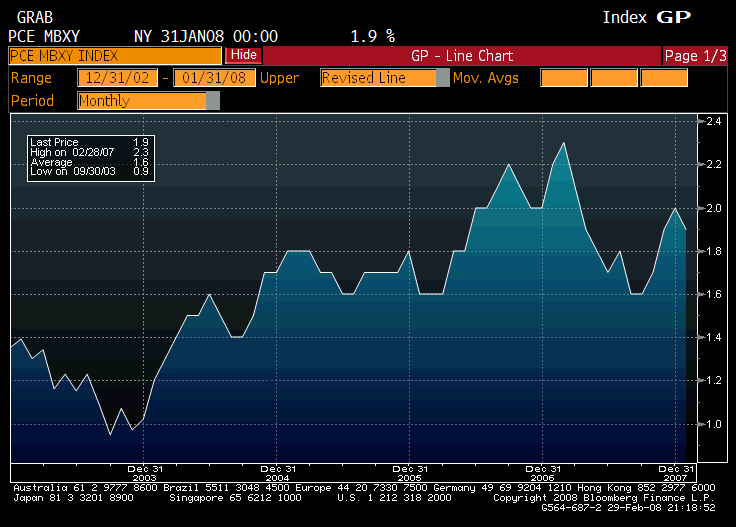

2008-02-29 Personal Consumption Expendatures Market Based Core YoY

Personal Consumption Market Based Core YoY (Jan)

Survey n/a
Actual 1.9%
Prior 2.0%
Revised n/a

Also as above. Ok, but threatening to move higher and be very costly to bring back down.
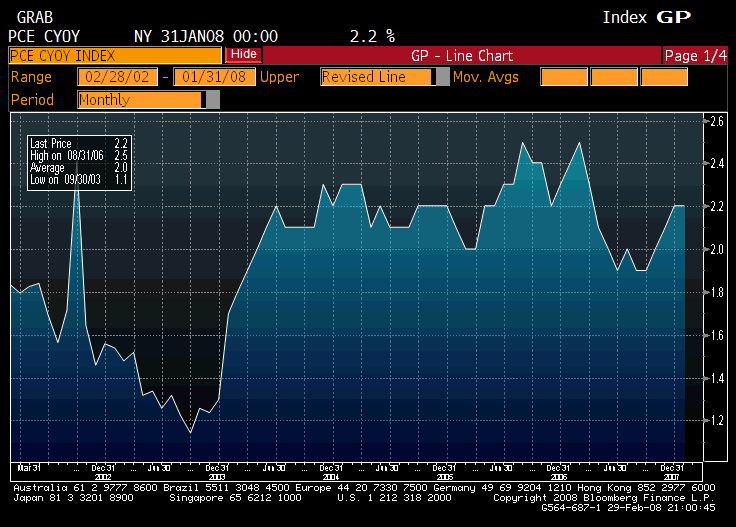

2008-02-29 PCE Core YoY

PCE Core YoY (Jan)

Survey 2.2%
Actual 2.2%
Prior 2.2%
Revised n/a

As above.


2008-02-29 Chicago Purchasing Manager

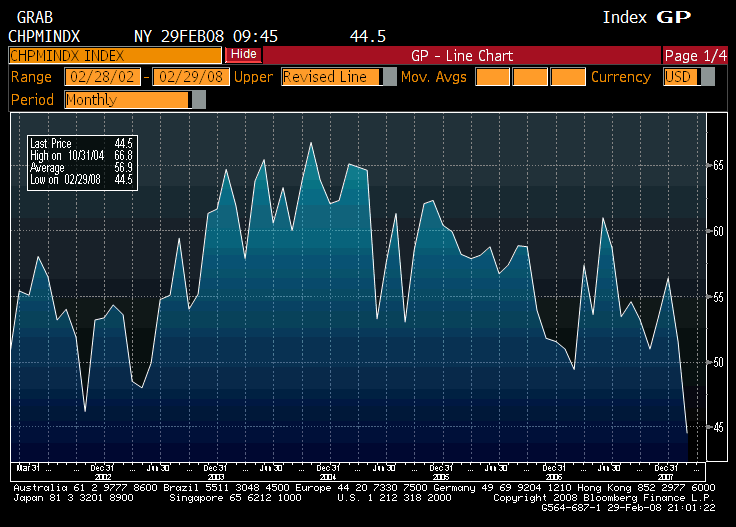
Chicago Purchasing Manager (Feb)

Survey 49.5
Actual 44.5
Prior 51.5
Revised n/a

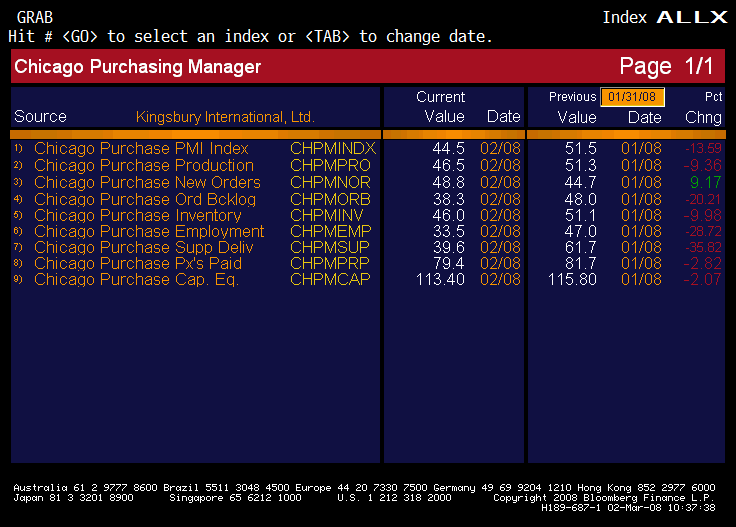
2008-02-29 Chicago Purchasing Manager TABLE

Chicago Purchasing Manager TABLE

Definitely not good, but like ISM, a survey that gets subjective responses, and price components remain high.

New orders up as well.
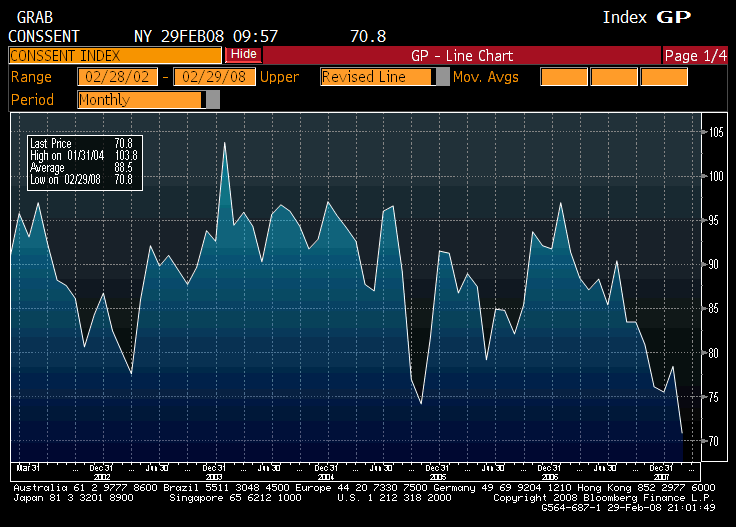

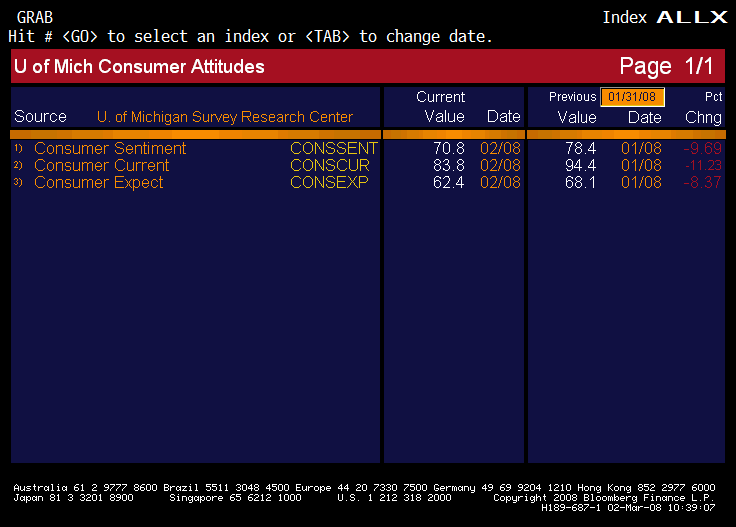
2008-02-29 U. of Michigan Confidence

U. of Michigan Confidence (Feb F)

Survey 70.0
Actual 70.8
Prior 69.6
Revised n/a

2008-02-29 U of Michigan Confidence TABLE

U. of Michigan Confidence TABLE

While better than expected, does not look good.

And one year inflation expectations are up to 3.6%.
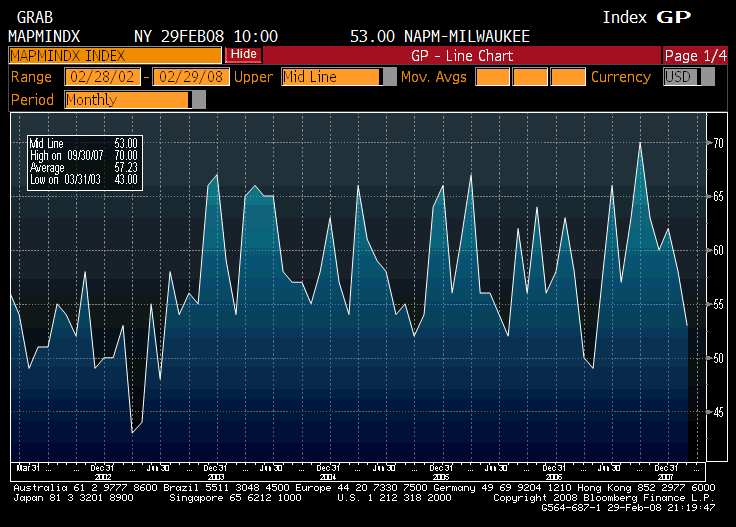

2008-02-29 NAPM Milwaukee

NAPM-Milwaukee (Feb)

Survey n/a
Actual 53.0
Prior 58.0
Revised n/a

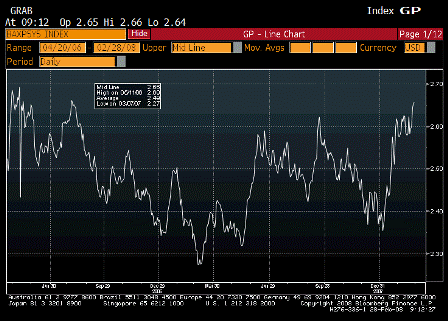
Below expectations, but positive. Probably won’t get reported anywhere else..
Posted in Daily | No Comments »

Re: GDP/claims

Posted by WARREN MOSLER on 28th February 2008

(an interoffice email)

On Thu, Feb 28, 2008 at 9:38 AM, Karim wrote:


  • Housing and business capex weaker than originally estimated; exports stronger
  • All above offset to leave gwth at 0.6% annualized in Q4

Yes, nominal growth falls to 3.3% from 6.0% in Q3 as well.


  • More important news is claims, which corroborate recent weak survey data (Conf Board, ISM)
    • Initial now at 373k (prior revised from 349k to 354k)
    • Continuing up 21k on week to a new cycle high of 2807k
    • Higher continuing claims reflect lack of hiring, higher initial claims reflect new layoffs

Yes, up in a new range. Q1 looking near zero as widely anticipated. Exports may be strong enough to keep the economy out of recession, but not much more without a March recovery.

Crude back over $100, $ down some, commodities up some, etc.

Weakness and inflation continue.

Posted in Email | No Comments »

Bloomberg: Calpers to Increase Commodity Assets to as Much as $7.2 Billion

Posted by WARREN MOSLER on 28th February 2008

And 3% of assets is on the low side. I think most were targeting 4% allocations, and now I’m hearing some are moving north of 10%, which should keep the commodities going for quite a while.

Calpers to Increase Commodity Assets to as Much as $7.2 Bil

by Saijel Kishan

(Bloomberg) The California Public Employees’ Retirement System, the largest U.S. pension fund, will increase investment in commodities to as much as $7.2 billion in the next two years as raw materials prices surge to records.

Calpers, which has $240 billion in assets, agreed at a Feb. 19 board meeting to invest between 0.5 percent and 3 percent of its assets in commodities through 2010, said Clark McKinley, a spokesman for the Sacremento, California-based fund.

“We plan on ramping up the program by hiring additional staff,” he said by phone yesterday. “We are excited about commodities, which have performed exceptionally well for us.”

The fund in March invested $450 million in commodities, its first such investment, by tracking the Standard & Poor’s GSCI index of 24 commodities. The index has returned 10 percent so far this year, adding to a 33 percent gain in 2007, as oil rose above $100 a barrel and wheat breached $13 a bushel for the first time. Gold and platinum also climbed to all-time highs.

Calpers, which covers the benefits of more than 1.5 million California state and local government employees, will set the proportion of assets invested in commodities “depending on market opportunities,” McKinley said.

The fund plans to allow its staff to actively manage some of its commodity investments this year, he added.

Posted in Articles | No Comments »

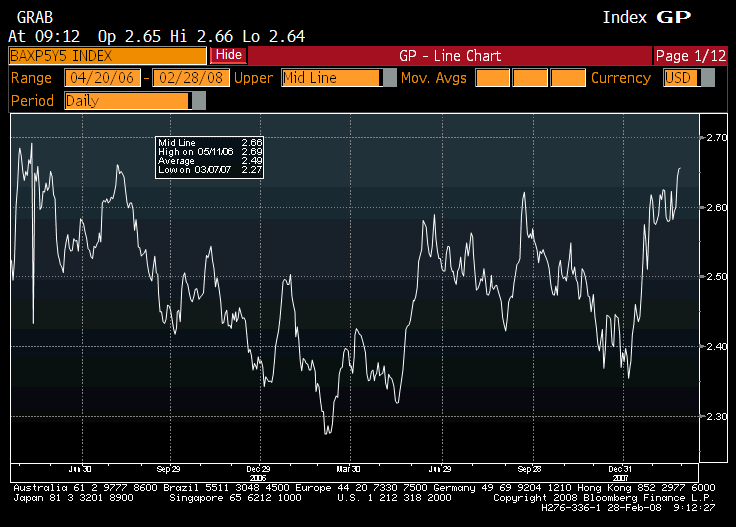
TIPS 5yr 5yr fwd

Posted by WARREN MOSLER on 28th February 2008

One of the Fed’s favorite inflation expectation indicators continues to look to be breaking out.

All pre/post ‘July 2006 pause’ progress has been reversed.

2008-02-28 TIPS 5yr 5yr fwd

TIPS 5yr 5yr fwd

Posted in Inflation | No Comments »

Re: Bernanke/data

Posted by WARREN MOSLER on 28th February 2008

(an interoffice email)

Yes, and he reaffirmed that he’s using the futures prices to predict where prices are going.  He pointed to crude being at $95 in the back months and stated that translates to a forecast for prices to come down from current levels.

Also indicated the lower dollar is useful for bringing down the trade deficit.  This ‘works’ for as long as US labor costs are ‘well anchored’.  Congress didn’t grasp this part, as it no doubt would have evoked quite an outcry if they had understood it.

Bernanke plainly stated he considered export growth a desired outcome versus domestic consumption.

Initial claims telling today.  Other numbers point to surprises on the upside.  This could be partially tempered by Q4 GDP being revised up.

FF futures already discounting cuts to below 2% over the next six months.

While crude inventories are up, markets are saying it’s ‘desired’ inventory as the term structure is still backwardated and WTI is still higher than Brent.

On Wed, Feb 27, 2008 at 12:32 PM, Karim wrote:
All you need to know about BB’s testimony courtesy of the Xinhua news agency:

WASHINGTON, Feb 27, 2008 (Xinhua via COMTEX) — Federal Reserve Chairman Ben

Bernanke told Congress on Wednesday the central bank will again lower interest

rates to boost U.S. economy.


Other highlights:


Commenting on new Fed forecasts from last week:

The risks to this outlook remain to the downside.  The risks include the possibilities that the housing market or labor market may deteriorate more than is currently anticipated and that credit conditions may tighten substantially further.


… financial markets continue to be under considerable stress


Important comment on the time frame over which policy should aim to attain objective inflation rates

The inflation projections submitted by FOMC participants for 2010–which ranged from 1.5 percent to 2.0 percent for overall PCE inflation–were importantly influenced by participants’ judgments about the measured rates of inflation consistent with the Federal Reserve’s dual mandate and about the time frame over which policy should aim to attain those rates.


Concluding comments highlight downside risks to growth and inflation pressures but when addressing ACTION, only mentions supporting growth and providing insurance against downside risks.

A critical task for the Federal Reserve over the course of this year will be to assess whether the stance of monetary policy is properly calibrated to foster our mandated objectives of maximum employment and price stability in an environment of downside risks to growth, stressed financial conditions, and inflation pressures.  In particular, the FOMC will need to judge whether the policy actions taken thus far are having their intended effects.  Monetary policy works with a lag.  Therefore, our policy stance must be determined in light of the medium-term forecast for real activity and inflation as well as the risks to that forecast.  Although the FOMC participants’ economic projections envision an improving economic picture, it is important to recognize that downside risks to growth remain.  The FOMC will be carefully evaluating incoming information bearing on the economic outlook and will act in a timely manner as needed to support growth and to provide adequate insurance against downside risks.


Data-wise, more of the same:

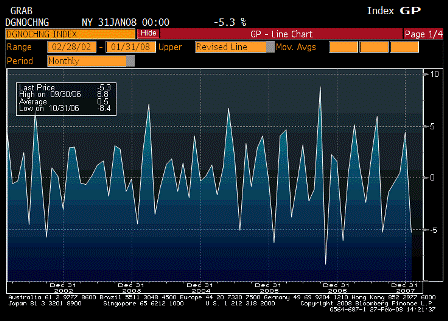
  • Durable goods orders down 5.3% after 4.4% rise last month. Core component down 1.4% after 5.2% rise. Capex too small a part of economy and potential rates of change too little to have much bearing on end growth at this stage.
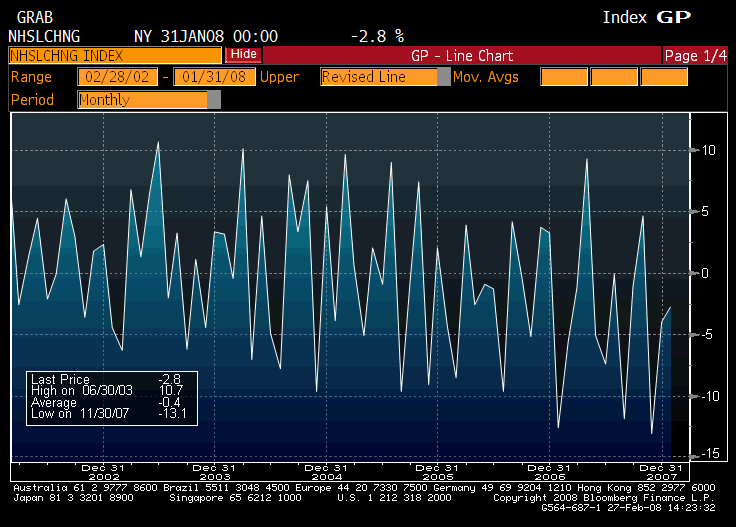
  • New home sales down another 2.8% in January and mths supply makes a new high, rising from 9.5 to 9.9; Y/Y median price drops to -15.1% from -7.8%

Posted in Email, Fed, Inflation, Interest Rates, Oil | No Comments »

New home sales

Posted by WARREN MOSLER on 28th February 2008

Weak winter sales, but the absolute number of homes in inventory did go down again and is well off the highs.

A modest pickup in the sales rate will now translate into a larger drop in the number of months of inventory.

The median price is more a function of which category of houses are selling.

The first quarter is looking weak domestically. Whether GDP goes negative or not will be a function of export strength.

New Home Sales Take Biggest Fall in Nearly 13 Years

(Reuters) New U.S. single-family home sales fell 2.8 percent in January to the lowest rate in nearly 13 years while the median sales price slipped and the housing overstock shrank, according to a government report on Wednesday that delivered more grim news for the ailing housing sector.

AP
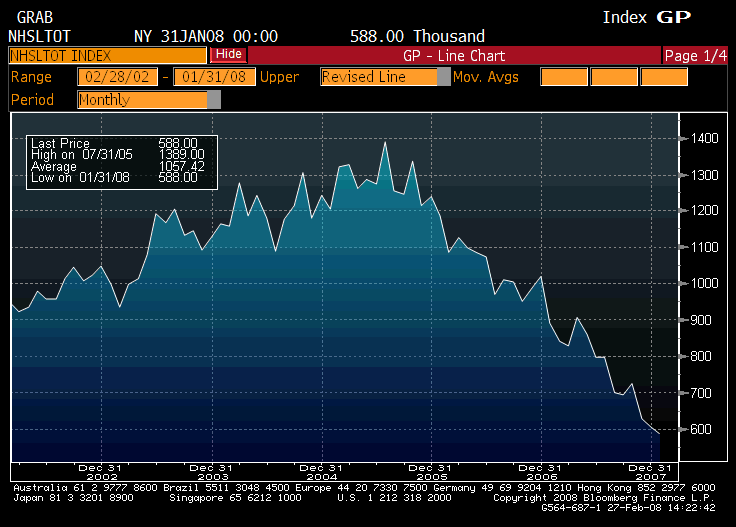
New home sales fell to an annual rate of 588,000 from an upwardly revised rate of 605,000 in December, the Commerce Department said.

Economists polled by Reuters were expecting January sales to fall to an annual rate of 600,000 from the December previously reported rate of 604,000.

In January, the median sales price for a new home fell 15.1 percent $216,000 from $254,400 a year ago.

Posted in Articles, Housing | No Comments »

Bernanke testimony

Posted by WARREN MOSLER on 27th February 2008

Mercantilism is alive and well

Most telling statement when asked about what he wanted for the economy-

moderate domestic consumption, more investment, and more exports to eliminate the trade deficit.
(I’m looking for the transcript now to get the exact quotes.)

This fits with the policy of a lower interest rates, lower $, lower domestic real consumption due to higher import prices, and higher exports to sustain demand (at the ‘expense’ of the country you are exporting to who ‘loses’ demand for its products). This can be done for as long as nominal domestic wages remain ‘well anchored’ thereby reducing real wages, particularly vs our intended markets.

This is the old ‘beggar thy neighbor’ policy last seen in the 1930’s. The purpose was to accumulate the world’s gold supply, and increase ‘national savings.’ The policy was called mercantilism. It’s the logical end that follows from being on a gold standard.
A trade surplus tended to increase gold reserves, while a trade deficit tended to drain gold reserves.

Today we have non convertible currency, so government accumulation of its own currency per se is meaningless. However, we have retained some of the gold standard accounting nomenclature, such as ‘national savings’ which still features govt. accumulation of it’s own currency (as well as foreign exchange, which at least does represent value).

Fed Chairman Bernanke, the student of the great depression of the 30’s, sees the tail risk as that of gold standard deflationary collapses, and is cutting interest rates to bring the $ down and increase exports. He deems trade deficits ‘bad’ and ‘unsustainable,’ trade surpluses ‘good’ and ‘wealth enhancing,’ and increasing ‘national savings’ the mark of success.

(Mainstream economics, with all its shortcomings, does recognize the differences between convertible and non convertible currency regimes that Bernanke seems to be missing.)

Additionally Chairman Bernanke made it clear today that he sees lower futures prices for crude oil, a non perishable commodity, as indicative of market expectations for future prices, and is making decisions on that basis.

Ironically, the backwardated crude market is the result of the Saudis/Russians acting as swing producer setting price and letting quantity adjust (imperfect competition), which is functionally an engineered spot ’shortage’ that supports price.

This brings us back to the present condition of the US economy-

Weak domestic real demand due to ‘well anchored nominal wages’ and falling real wages,

GDP muddling through with the support of booming export demand and a falling trade deficit,

And cost push inflation accelerating.

However,

Based on today’s testimony, the FOMC seems fine with the lower $ and the associated rising costs of imports, as the weak $ supports export growth.

It will get concerned about inflation when it sees signs unit labor costs are accelerating.

Posted in Fed | 6 Comments »

2008-02-27 US Economic Releases

Posted by WARREN MOSLER on 27th February 2008

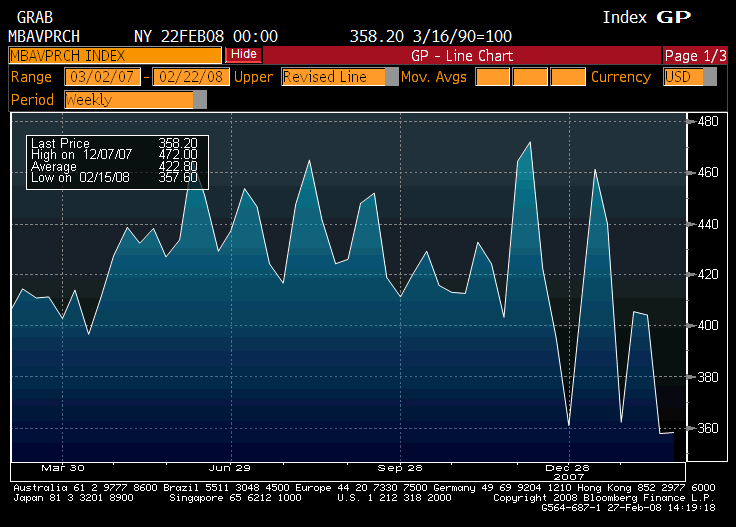
2008-02-27 MBAVPRCH

MBAVPRCH Index (Feb 22)

Survey n/a
Actual 358.2
Prior 357.6
Revised n/a

While still winter numbers, this is nonetheless looking very weak.

No way to tell if it’s more than loss of market share to banks, but other winter housing numbers are also weak.


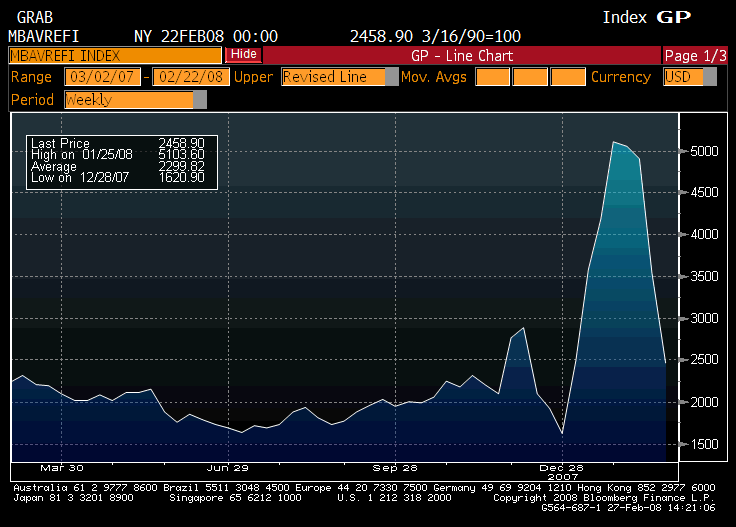
2008-02-27 MBAVREFI

MBAVREFI Index (Feb 22)

Survey n/a
Actual 2458.9
Prior 3533.8
Revised n/a

Weak.


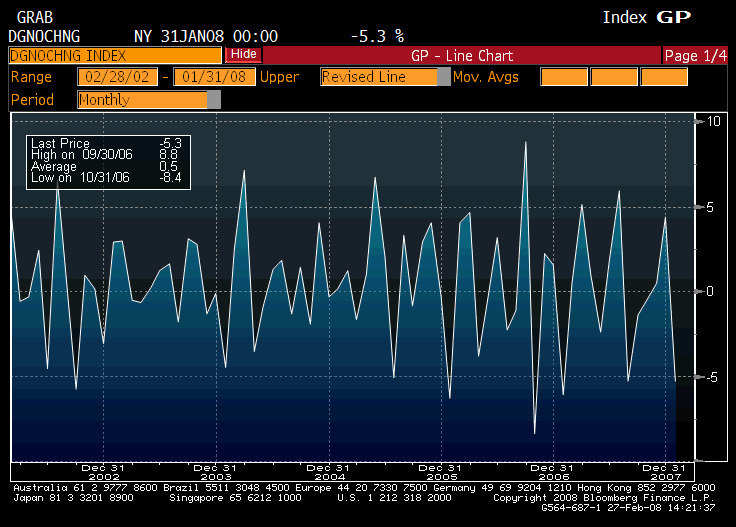
2008-02-27 Durable Goods Orders

Durable Goods Orders (Jan)

Survey -4/0%
Actual -5.3%
Prior 5.2%
Revised 4.4%

Weak.


2008-02-27 Durable Goods Orders

Durable Goods YoY (Jan)

Survey n/a
Actual 3.0%
Prior 4.2%
Revised n/a

Weak.


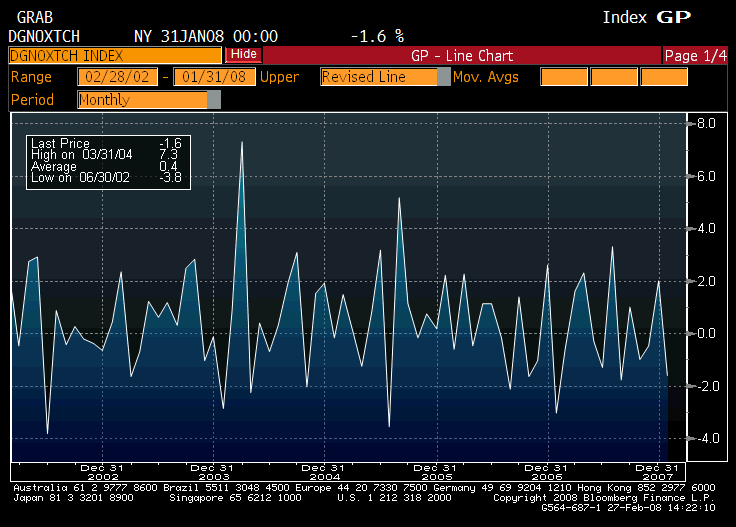
2008-02-27 Durables Ex Transporation

Durables Ex Transportation (Jan)

Survey -1.4%
Actual -1.6%
Prior 2.6%
Revised 2.0%

Weak.


2008-02-27 New Home Sales

New Home Sales (Jan)

Survey 600K
Actual 588K
Prior 604K
Revised 605K

Weak.


2008-02-27 New Home Sales MoM

New Home Sales MoM (Jan)

Survey -0.7%
Actual -2.8%
Prior -4.7%
Revised -4.0%

Weak.


 Gives less reason to think January payrolls will be reversed very much higher.

Posted in Daily | No Comments »

Two quick comments on inflation

Posted by WARREN MOSLER on 27th February 2008

  1. Bernanke may be reminded of the reason the dual mandate includes inflation - voters don’t like inflation even more than they don’t like unemployment.
  1. As inflation rates rises into the March 18 meeting, with the FF rate at 3% the real rate falls, which the FOMC sees as ‘easier’ policy.

    Posted in Fed, Inflation | No Comments »

    Additions to yesterday’s review

    Posted by WARREN MOSLER on 27th February 2008

    Forgot to include the influence of the 8,000 lb gorilla I’ve been advancing for the last few years!

    Supporting GDP

    1. Pension funds adding to allocations for passive commodity strategies

    Sources of inflation

    1. Pension funds adding to allocations for passive commodity strategies
    2. Pension funds contributing to the $ decline by allocating funds away from domestic equities to foreign equities
    3. Sovereign wealth funds allocating to passive commodity strategies

    Errors made by the Fed

    1. Failure to recognize the influence of pension funds on inflation and aggregate demand
    2. Failed to understand reserve accounting and liquidity issues
      1. Thought open market operations altered functional quantitative measures, not just interest rates
      2. Delayed implementing the TAF for several months to accept additional bank assets as collateral
      3. Failed to recognize that the liability side of Fed member banks is not an appropriate source of market discipline

    Posted in Fed, Inflation | No Comments »

    Re: update

    Posted by WARREN MOSLER on 27th February 2008

    Dear Philip,

    Seems there’s a break between Mishkin and Kohn that previously wasn’t there.
    Markets are thinking Kohn supports a 50 cut and that he and Bernanke are alligned.

    Today Bernanke may show whether he leans towards Mishkin, the co academic, or Kohn, more the practitioner.

    Meanwhile, another ‘inflation day’ with oil and commodities up, $ down, and headlines like ‘Honda says no recession in US.’

    All the best,
    Warren

    On 27 Feb 2008 09:09:43 +0000, Prof. P. Arestis

    wrote:
    >
    > Dear Warren,
    >
    > Many thanks.
    >
    > > Do you think Kohn’s speech indicates he’s ready to cut another half point
    > > on Mar 18?
    >
    > I think the simple answer to the question is probably no with a question
    > mark. I say this in the sense that before March 18 we will probably hear
    > more about Kohn’s views, which may be clearer in terms of whether he is
    > ready for another half point reduction. However, in terms of the analysis
    > he offered in the piece you kindly sent me I did not see anything that
    > suggested half point cut, although there is plenty in the piece to suggest
    > that he is in favour of more cuts. I say this in that although he sees
    > problems with the real economy he is also mindful of inflation, but he is
    > not an ‘inflation nutter’ as some others are. So at this stage I believe he
    > will go for a cut but not as much as half point.
    >
    > What do you think?
    >
    > Best wishes, Philip

    Posted in Email, Fed | No Comments »

    Inflation, growth, and Fed policy

    Posted by WARREN MOSLER on 26th February 2008

    Stocks up big, oil up big, dollar down big, and interest rates lower. How does this happen?

    Review

    Twin themes remain

    • weakness
    • inflation

    Sources of weakness

    1. Shrinking gov budget deficit caused the financial obligations ratio to get too high by Q2 2006 to support the private sector credit growth needed to sustain previous levels of aggregate demand.
    2. Subprime business plan failed (mainly due to lender fraud) and removed that bid from the housing market.
    3. Lower interest rates reduce personal/household income.

    Supporting GDP

    1. Exports booming due to a reduced desire of non residents to accumulate $US financial assets. (This drives the $US down to levels where non residents are spending them on US goods and services.)
      1. Paulson branding any country that buys $ a ‘currency manipulator’
      2. Apparent lack of Fed concern about inflation discouraging holders of $US financial assets
      3. Bush policies discouraging ‘less then friendly’ oil producers from accumulating $US financial assets
    2. Govt. spending moved forward from 07 to 08 now kicking in.
    3. Fiscal package begins to distribute funds in May.
    4. Pension funds adding to allocations for passive commodity strategies

    Sources of Inflation

    1. Sufficient demand for Saudis/Russians to act as swing producers and set crude prices as high as they want to
    2. Biofuels linking energy prices to food prices as we burn up the world’s food supply for fuel
    3. Govt. payrolls and transfer payments indexed to CPI
    4. Weak $US policies driving higher import and export prices
    5. Pension funds adding to allocations for passive commodity strategies
    6. Pension funds contributing to the $ decline by allocating funds away from domestic equities to foreign equities
    7. Sovereign wealth funds allocating to passive commodity strategies

    An export economy looks like this

    1. Weak domestic demand and domestic consumption
    2. Exports strong enough to sustain reasonable levels of employment (but generally not full employment)
    3. Employment and output stays reasonably high.
    4. Domestic prices are high enough relative to domestic wages to subdue domestic consumption.
    5. Foreigners ‘outbid’ domestics for the remaining output that thereby gets exported.
    6. The domestic economy works more and consumes less (lower standard of living), with the difference accounted for as ‘rising savings.’

    Mainstream history (not mine) will show the following errors made by the Fed

    1. They ‘paused’ a couple of years ago as the great commodity boom was hitting it’s stride, monetizing (whatever that is) the price increases, and allowing a relative value story to turn into an inflation story.
    2. They cut aggressively into a triple negative supply shock exacerbating the monetization (whatever that is) process due to the following fundamental errors of judgement:
      1. They read futures prices in food and energy as ‘expectations’ of lower prices in the future, rather than as indicators of current inventory conditions.
      2. They assumed gold standard tail risks to a non convertible currency regime.
      3. They failed to recognize the source of rising crude prices was foreign monopoly pricing.
      4. They delayed introducing the TAF for several months.
      5. They pushed the President and Congress into increasing the budget deficit with an inflationary cash give handout.
    3. Failure to recognize the influence of pension funds on inflation and aggregate demand
    4. Failed to understand reserve accounting and liquidity issues
      1. Thought open market operations altered functional quantitative measures, not just interest rates
      2. Delayed implementing the TAF for several months to accept additional bank assets as collateral
      3. Failed to recognize that the liability side of Fed member banks is not an appropriate source of market discipline

    Back to the present

    • Stocks are up as financial risks ease with the monolines sorting things out, and energy and export businesses boom.
    • Stocks are up as markets believe the Fed doesn’t care about inflation and will leave rates low for an extended period of time.
    • Crude is up as Saudis/Russians continue to hike prices.
    • The falling dollar results in higher import prices including gold, silver, copper, and most everything else.

    Interest rates are down as markets read the Kohn speech as saying the Fed expects inflation to come down so there’s no need to be concerned or take action. And inflation is a lagging indicator that historically comes down after the Fed cuts rates when the economy weakens.

    Posted in Fed, Inflation, Interest Rates, USA | No Comments »

    Kohn speech

    Posted by WARREN MOSLER on 26th February 2008

    After the speech, crude up $1.61 and back over $100.
    Yields down on fixed income as markets anticipate Fed won’t respond to inflation anytime soon:

    February 26, 2008

    The U.S. Economy and Monetary Policy

    (SNIP)

    Several major developments are shaping current economic performance, the outlook, and the conduct of monetary policy. The most prominent of these developments is the contraction in the housing market that began in early 2006. Both the prices and pace of construction of new homes rose to unsustainable levels in the preceding few years. For a time, the resulting correction was largely confined to the housing market, but the consequences of that correction have spread to other sectors of the economy.

    The financial markets are playing a key role in the transmission of the housing downturn to the rest of the economy.

    (SNIP)

    The result has been a substantial tightening in credit availability for many firms and households.

    At the same time, continued sizable increases in the prices of food, energy, and other commodities have raised inflation. To some extent, those increases have resulted from strong demand in rapidly growing emerging-market economies, like China and India. But the increases likely also reflect conditions such as adverse weather in some parts of the world, the use of agricultural commodities to produce energy, and geopolitical developments that threaten supplies in some petroleum-producing centers. The higher prices have eroded the purchasing power of household income, adding to restraint on spending.

    (SNIP)

    Recent Economic and Financial Developments

    The pace of real economic activity stepped down sharply toward the end of last year and has remained sluggish in recent months. Real gross domestic product (GDP) is estimated to have risen only slightly in the fourth quarter. The contraction in the housing market continues to drag down economic growth. Declines in real residential investment subtracted nearly 1 percentage point from the overall increase in real GDP in 2007. Even so, the inventory of unsold new homes remains unusually high, because the demand for housing has fallen about as rapidly as the supply. Problems in the subprime market have virtually cut off financing in this sector. Prime jumbo mortgages are being made, but the lack of a secondary market has caused the spread between rates on these mortgages and on those that have been eligible for purchase by Fannie Mae and Freddie Mac to widen substantially. Even the standards for conforming mortgages have been tightened of late. Weak demand, in turn, is leading to widespread declines in the actual and expected prices of houses, further discouraging buyers. Starts of new single-family homes continued to fall in January, dropping to fewer than 750,000 units–a level of activity more than 1 million units below the peak in early 2006. Judging from the further decline in permits last month, additional cutbacks in construction are likely. It appears that the correction in the housing market has further to go.

    For the better part of the past two years, the trouble in the housing market was contained; however, over the past several months, the weakness appears to have spread to other sectors of the economy. Tighter credit, reductions in housing and equity wealth, higher energy prices, and uncertainty about economic prospects seem to be weighing on business and household spending. Labor demand has softened in recent months. Private nonfarm payrolls were little changed in January, and the unemployment rate moved up to 4.9 percent, on average, during December and January, after remaining around 4-1/2 percent from late 2006 through most of 2007. The higher level of weekly claims for unemployment insurance suggests continued softness in employment this month.

    Agreed, the economy has hit the ’soft spot’ previously forecast by the Fed and private economists.

    Apart from the labor market, the hard data on economic activity in the first quarter are limited, but, on the whole, the data suggest economic activity has remained very sluggish. Retail sales were up moderately in nominal terms in January, but after adjusting for the rise in prices of consumer goods, real spending on non-auto goods appears to have been little changed last month. In addition, unit sales of new motor vehicles weakened. Total industrial production rose just 0.1 percent in January for a second consecutive month, and manufacturing output was unchanged. Much of the other information about the current quarter has come in the form of surveys of business and consumers–and most all of it has been downbeat. That said, I can still see a few bright spots. One is that the level of business inventories does not appear worrisome at present. Another is that international trade continued to be a solid source of support for the economy through the end of last year. The worsening financial conditions and slower growth in the United States have had some effect on the rest of the world, but the prospects for foreign growth remain favorable.

    Agreed, weak domestic demand supported by rising exports.

    The most recent news on inflation–the January report on the consumer price index (CPI)–was disappointing. Once again, total or headline CPI was boosted by a jump in energy prices and relatively large increases in food prices; last month’s rise left the twelve-month change in the overall CPI at 4.3 percent–twice the pace a year ago. In addition, the January increase of 0.3 percent in the CPI excluding food and energy was slightly higher than the average monthly rate in 2007. Nonetheless, the twelve-month change in this measure of core inflation, at 2-1/2 percent, was still slightly below the rate one year earlier. The recent readings on core inflation suggest that the higher costs of energy, a pickup in prices of imported goods, and, perhaps, the persistent upward price pressures in commodity markets may be passing through a bit to core consumer prices.

    Headline passing through to core - not good.

    The Implications of Financial Stress for the Economic Outlook

    (SNIP)

    The pressures from the financial turmoil have been most intense for those financial intermediaries that have been exposed to losses on mortgages and other credits that are repricing, as well as for those institutions now required to bring onto their balance sheets loans that previously would have been sold into securities markets. As those intermediaries take steps to protect themselves from further losses and conserve capital, and as investors more broadly have responded to the evolving risks, spreads on household and business debt in securities markets have widened, the availability of bank credit has decreased, and equity prices have weakened.

    In addition to the drying up of large portions of mortgage finance that I referred to previously, conditions have firmed on loans for a variety of other purposes. Responses to our Senior Loan Officer Opinion Survey in January showed that banks have tightened terms and standards for household and commercial mortgages, commercial and industrial loans, and consumer loans.

    The Fed puts a lot of weight on this and reads it differently than I do. Yes, they have tightened standards, but that doesn’t mean those who had previously qualified no longer qualified under the new standards. For example, requiring a larger down payment is considered tightening, and there’s no evidence yet that would be borrowers don’t simply put more money down. Same with other ‘tightening standards’ issues.

    In corporate bond markets, spreads have been widening on both investment- and speculative-grade issues. Lenders are demanding much higher risk premiums for commercial real estate loans. And equity prices have fallen substantially over the past seven months, reducing household wealth and increasing the cost of raising equity capital for businesses.

    All true, but part of the great repricing of risk. Arguably spreads were unsustainably narrow a year ago.

    To be sure, the easing of monetary policy that I will be discussing in a minute has, quite deliberately, been intended to offset the effect of this tightening, resulting in some borrowers seeing lower interest rates. But financing costs have risen, on balance, for riskier credits, and almost all borrowers are dealing with more cautious lenders who have adopted more stringent standards. Those financial market developments are, in many respects, a healthy correction to previous excesses.

    Yes, agreed with that.

    But, in some cases, they may represent an overreaction, or at least positioning for the small probability of very adverse economic conditions. In any case, they have the potential to adversely affect household and business spending.

    Yes, they have that potential. And regulatory over reach is also a problem he doesn’t address, as the OCC is unnecessarily making things more difficult for small banks to function ‘normally’.

    The recovery in financial markets is likely to be a prolonged process. The length of the recuperation will depend importantly on the course of the economy, particularly on developments in the housing market. If the deterioration in the housing market were greater than expected in coming months, the losses borne by financial institutions would be even greater, and lenders might further reduce credit availability. More widespread macroeconomic weakness could make lenders more cautious and could cause the financial problems to spread further. The recent problems of financial guarantors, with possible implications for municipal bond markets as well as for bank balance sheets, are an indication that the financial sector remains vulnerable.

    Agreed that parts of the financial sector remains vulnerable, while others are doing exceptionally well.

    Even in a more favorable economic environment, some time is likely to be required to restore the functioning and liquidity of a number of markets.

    (SNIP)

    The Monetary Policy Response

    (SNIP)

    As the deterioration in financial markets increasingly has threatened to hold down spending and employment, the FOMC has eased monetary policy, reducing the federal funds rate target by 2-1/4 percentage points since the turmoil erupted in August. Those actions have been intended to counteract the effects on the overall economy of tighter terms and conditions in credit markets, the drop in equity and housing wealth, and the steep decline in housing activity. Our objective has been to promote sustainable growth and maximum employment over time.

    (SNIPS BELOW)

    What policy can do is attempt to limit the fallout on the economy from this adjustment.

    Lower interest rates should support aggregate demand over time, even in the face of widespread contraction in the supply of credit.


    Among other things, lower rates should facilitate the refinancing of mortgage loans, and they will hold down the cost of capital to business.

    Easier policy should also support asset prices–or at least cushion declines that otherwise would have occurred.

    And expected policy easing likely contributed to the drop in the foreign exchange value of the dollar, which is bolstering our exports.

    Yes, the ‘inflate your way out of debt’ approach. Highly unusual for a central bank to aggressively do this. Harks back to the ‘beggar thy neighbor’ policies of the 1930s.

    The extent of the financial adjustment, as I mentioned previously, is itself highly dependent on how housing and the economy evolve. Part of the rise in risk spreads, reduction in credit availability, and the declines in stock prices in the past few months reflect investor efforts to protect themselves against the potential for very adverse economic outcomes–that is, the exposures and losses that would accompany a persistent steep decline in house prices and a significant recession. Of course, these actions–reducing exposures, tightening credit standards, demanding extra compensation for taking risk–themselves make these “tail risk” scenarios even more likely. In circumstances like these, the decisions of policymakers must take account of not only the most likely course of the economy, but also the possibility of very unfavorable developments.

    Not including inflation?

    Doing so should reduce the odds on an especially adverse outcome not only by having policy a little easier than otherwise, but also by reassuring lenders and spenders that the central bank recognizes such a possibility in its policy deliberations. Whether the Federal Reserve has done enough in this regard is a question this policymaker will be weighing carefully over coming months.

    Even as we respond to forces currently weighing on real activity, we must also set policy to resist any tendency for inflation to increase on a sustained basis. Allowing elevated rates of inflation to become entrenched in inflation expectations would be costly to reverse, constrain our ability to cushion further downward shocks to spending, and result over time in lower and less stable economic expansion. Inflation expectations generally have appeared reasonably well anchored, giving the FOMC room to focus on supporting economic growth. Moreover, as I will explain below, for a variety of reasons, I do not expect the recent elevated inflation rates to persist. In my view, the adverse dynamics of the financial markets and the economy have presented the greater threat to economic welfare in the United States. But the recent information on prices underlines the need to continue to monitor the inflation situation very carefully.

    The Outlook for Economic Activity and Inflation

    How long the adjustment in financial markets will take and the consequences of that adjustment for economic activity are subject to considerable uncertainty. In my view, the most likely scenario is one in which the economy experiences a period of sluggish growth in demand and production in the near term that is accompanied by some further increase in joblessness.

    New building activity will continue to decline until the overhang of inventories of unsold homes has been substantially reduced, and the demand side of the market is not likely to revive appreciably until buyers sense that price declines are abating and financing conditions for mortgages are improving. Consumer spending will be damped by the effects on real incomes of a weak labor market and rising energy prices and by the effects of declines in the stock market and home prices on household wealth. Business spending on capital equipment should be held down by slower sales and production and by caution in a very uncertain economic environment. Nonresidential construction is likely to lose some momentum in the wake of both weak growth in overall economic activity and tighter credit. Some modest offset to these areas of weakness should come from export demand, which should be boosted by the lagged effects of recent declines in the dollar and supported by still-solid growth abroad.

    Seems he doesn’t realize export demand is part of the cause of higher prices, as non-residents compete with residents to buy the US output of goods and services. That’s what an export economy looks like, and this will continue for as long as non-resident desires to accumulate $US financial assets continues to fall.

    By midyear, economic activity should begin to benefit from several factors. One is the fiscal stimulus package that the Congress recently enacted. The rebates that households are scheduled to begin to receive in May should provide a temporary boost to consumption. Although the timing and the magnitude of the spending response is uncertain, economic studies of the previous experience suggest that a noticeable proportion of households are quite sensitive to temporary cash flow. The potential effects of the business incentives are perhaps more uncertain. Although economic theory suggests that they should bring forward some capital spending, past experience has been mixed.

    Second, the decline in residential investment should begin to abate later this year as the overhang of unsold homes is worked off, reducing what has been a significant drag on economic growth over the past two years. Finally, the declines in interest rates that began last summer should be supporting activity over coming quarters, and their effects should show through more clearly to improvements in economic activity as the stress in financial markets dissipates.

    Although a firming in the growth of economic activity after midyear now appears the most likely scenario, the outlook is subject to a number of important risks. Further substantial declines in house prices could cut more deeply into household wealth and intensify the problems in mortgage markets and for those intermediaries holding mortgage loans. Financial markets could remain quite fragile, delaying the restoration of more normal credit flows. As observed in the minutes of its most recent meeting, the FOMC has expressed a broad concern about the possibility of adverse interactions among weaker economic activity, stress in financial markets, and credit constraints.

    I expect the run-up in headline inflation to be reversed and core inflation to edge lower over the next few years. This projection assumes that energy and other commodity prices will level out, as suggested by the futures markets.

    No other reasons? Not much to bet the ranch on? And futures prices for non perishables are not about expectations, but about inventory conditions. Contango indicates a surplus of desired spot inventories and backwardation a shortage of desired spot inventories.

    The current backwardated term structure of oil and other futures is indicating shortages, which, if anything, tell me the risk is more to the upside than the downside, as well as support my position that the Saudis/Russians are acting as swing producers and setting price.

    Moreover, greater slack in the economy should reduce pressure on prices and wages.

    Maybe, but also a risky stance.

    Rising import prices are in fact rising real wages for US, as many imports have high labor contents.

    And given rising import prices of labor intensive goods and services due to the weak $, lower US domestic real wages shift production back to domestic firms, who support US nominal wages and keep employment firmer than otherwise.

    Despite high resource utilization over the past couple of years and periods of elevated headline inflation, labor cost increases have remained quite moderate, and inflation expectations remain reasonably well anchored.

    As above, rising import prices represent rising labor costs, and inflation expectations have dropped to only ‘reasonably’ well anchored.

    Nonetheless, policymakers must remain very attentive to the outlook for inflation. As I mentioned earlier, the recent uptick in core inflation may reflect some spillover of the higher costs of food, energy, and imports into core prices.

    To the mainstream economists, this is a serious development.

    And the prices of crude oil and other commodities have moved up further in recent weeks. A related concern is that inflation expectations might drift higher if the current rapid rates of headline inflation persist for longer than anticipated or if the recent easing in monetary policy is misinterpreted as reflecting less resolve among Committee members to maintain low and stable inflation over the medium run. Persistent elevated inflation would undermine the performance of the economy over time.

    Worse, to a mainstream economist, including Governor Kohn, it’s a necessary condition for optimal growth and employment.

    Conclusion

    These have been difficult times for the U.S. economy. The correction of excesses in sectors of the economy and financial markets has spilled over more broadly. Growth has slowed, and unemployment has increased; both borrowers and lenders are facing problems, and the functioning of the financial markets has been disrupted. At the same time, inflation has risen.

    Yes, weakness and higher prices.

    I believe we will see a return to stronger growth, lower unemployment, lower inflation and improved flows in financial markets, but it probably will take a little while.

    This ‘belief’ is at best scantily supported in this speech. Lower inflation because futures are lower? Lower employment/output gap and bringing inflation down to comfort zone at the same time?

    And adverse risks to this most likely scenario abound: Uncertainty could trigger an even greater withdrawal from risk-taking by households, businesses, and investors, resulting in more pronounced and prolonged economic weakness; events beyond our borders could continue to put upward pressure on inflation rates.

    Yes.

    But we should not lose sight of some fundamental strengths of our economy. Our markets have proven to be flexible and resilient, able to absorb shocks, and quick to adapt to changing circumstances. Those markets reward entrepreneurship and risk-taking, and many people are looking for opportunities to buy distressed assets and restructure and strengthen businesses to take advantage of the economic rebound that will occur. Monetary policy has proven itself, under a wide variety of circumstances, very effective in recent decades in damping inflation when needed

    Yes, but only by hiking rates. There is no other policy option for bringing down inflation.

    and in stimulating demand and activity when that has been appropriate. Our job at the Federal Reserve is to put in place those policies that will promote both price stability and growth over time. We have the tools.

    They have one tool - setting the interbank interest rates and other rates as desired.

    They have no way of directly increasing or decreasing aggregate demand. That requires direct buying or selling of actual goods and services, not just financial assets.

    Treasury spending/taxing directly add/removes demand.

    As Chairman Bernanke often emphasizes: We will do what is needed.

    Yes, to the best of their knowledge and ability.

    This is a relatively neutral speech with more inflation talk than in previous, dovish speeches.

    Conclusion:
    High February CPI numbers before the next meeting will make it very difficult for the FOMC to vote on a cut without a more than anticipated decline of economic activity.

    Posted in Fed | No Comments »

    2008-02-26 US Economic Releases

    Posted by WARREN MOSLER on 26th February 2008

    2008-02-26 Producer Price Index MoM

    Producer Price Index MoM (Jan)

    Survey 0.4%
    Actual 1.0%
    Prior -0.1%
    Revised -0.3%

    2008-02-26 PPI Ex Food & Energy MoM

    PPI Ex Food & Energy MoM (Jan)

    Survey 0.2%
    Actual 0.4%
    Prior 0.2%
    Revised n/a

    2008-02-26 Producer Price Index YoY

    Producer Price Index YoY (Jan)

    Survey 7.3%
    Actual 7.4%
    Prior 6.3%
    Revised n/a

    2008-02-26 PPI Ex Food & Energy YoY

    PPI Ex Food & Energy YoY (Jan)

    Survey 2.2%
    Actual 2.3%
    Prior 2.0%
    Revised n/a

    To high for the Fed and looking higher. Kohn speaking next today.

    In the early 70’s inflation kept going up, even after crude flattened out for several years after a fivefold+ jump,


    2008-02-26 S&P-CaseShiller Home Price Index

    S&P/CaseShiller Home Price Index (Dec)

    Survey n/a
    Actual 184.9
    Prior 188.8
    Revised 188.9

    2008-02-26 S&P-CS Composite-20 YoY

    S&P/CS Composite-20 YoY (Dec)

    Survey -9.7%
    Actual -9.1%
    Prior -7.7%
    Revised n/a

    2008-02-26 S&P-CS US HPI

    S&P/Case-Shiller US HPI (4Q)

    Survey n/a
    Actual 170.6
    Prior 180.5
    Revised 180.3

    2008-02-26 S&P-CS US HPI YoY%

    S&P/Case-Shiller US HPI YoY% (4Q)

    Survey n/a
    Actual -8.9%
    Prior -4.5%
    Revised -4.6%

    2008-02-26 Consumer Confidence

    Consumer Confidence (Feb)

    Survey 82.0
    Actual 75.0
    Prior 87.9
    Revised 87.3

    2008-02-26 Richmond Fed Manufact. Index

    Richmond Fed Manufact. Index (Feb)

    Survey -12
    Actual -5
    Prior -8
    Revised n/a

    2008-02-26 Housing Price Index QoQ

    House Price Index QoQ (4Q)

    Survey -1.0%
    Actual 0.1%
    Prior -0.4%
    Revised -0.2%

    Not released yet..

    ABC Consumer Confidence (Feb 24)

    Survey -
    Actual -
    Prior -37
    Revised -

    [comments]


    Posted in Daily | No Comments »

    Mishkin speech

    Posted by WARREN MOSLER on 25th February 2008

    Not a quick read, but telling - inflation risks seem to be overtaking concerns with the economy:

    Does Stabilizing Inflation Contribute to Stabilizing Economic Activity?

    (Interesting that this is a question)

    The ultimate purpose of a central bank should be to promote the public good through policies that foster economic prosperity. Research in monetary economics describes this purpose by specifying monetary policy objectives in terms of stabilizing both inflation and economic activity. Indeed, this specification of monetary policy objectives is exactly what is suggested by the dual mandate that the Congress has given to the Federal Reserve to promote both price stability and maximum employment.1

    Yes, just as the mainstream says, and FOMC voting member Fisher restate recently: price stability is a necessary condition for optimal long-term employment and growth.

    We might worry that, under some circumstances, the objectives of stabilizing inflation and economic activity could conflict, particularly in the short run. However, economic research over the past three decades suggests that such conflicts may not, in fact, be that serious. Indeed, stabilizing inflation and stabilizing economic activity are mutually reinforcing not only in the long run, but in the short run as well. In my remarks today, I would like to outline how economic researchers came to that conclusion, and in so doing, explain why it is so important to achieve and maintain price stab